I Have a Special Plan for This World: "No more worlds like this, no more days like that"

It’s not often that we get to feature apocalyptic audio recordings, especially of poetry. I Have a Special Plan For This World is the result of a collaboration between Thomas Ligotti (author) and the experimental band Current 93. Ligotti’s poetry describes a vision for his “special plan” which involves the destruction of this world and all worlds, perhaps even the destruction of reality itself. Current 93 provides an ominous soundtrack with Ligotti’s verses read broodingly by David Tibet. An oddity is the intro of the opening track, which was allegedly created by a mentally ill man who left tape recordings of his ramblings near Ligotti’s workplace.

As this recording is a mere 22 minutes long, it should be experienced firsthand. I Have a Special Plan for This World has been uploaded in its entirety to Youtube (see the link below). Though out of print, copies of the CD can be purchased second-hand through retailers such as Amazon.

Weirding the Apocalypse Part 1: Carnosaur (1993)

Scoring only 3.5 out of 10 stars on IMDb and 11% fresh on Rotten Tomatoes, the 1993 Jurassic Park knock-off Carnosaur (directed by Adam Simon and produced by Roger Corman) doesn’t get a lot of love. Technically, it isn’t a knock-off, as it’s loosely based on a 1984 novel by John Brosnan  (a.k.a. Harry Adam Knight), which itself predates  Crichton’s novel.  But the timing of the film’s release was certainly meant to cash in on the success of Jurassic Park, and even adds an additional callback by casting Diane Ladd, mother of Jurassic Park‘s Laura Dern, as a mad scientist.

Carnosaur doesn’t boast the then-cutting edge special effects of Jurassic Park. In fact, the dinosaurs are overly rubbery and the film as a whole is incredibly low budget, but in other respects, Carnosaur is the weirder, gorier, and more tantalizing of the two films.

Let me explain.

Despite Jeff Goldbloom’s character in Jurassic Park being quite delicious as the resident pessimist, like all Spielberg movies, the entire film is very much Up With People in its outlook. It’s comfortably anthropocentric, with dinosaurs being genetically engineered for the sole purpose of humans’ entertainment and corporate profit. Of course things go badly, but order is ultimately restored with humanity reasserting itself as the dominant species.

Carnosaur also has a plot involving the creation of genetically engineered dinosaurs, but with a twisted motive. Dr. Jane Tiptree (portrayed by Diane Ladd) is a female mad scientist (a rarity in horror films), who has a strange plan to save the earth. She has created and introduced a food-borne virus into poultry products that recodes human DNA in such a way as to cause women to give birth to dinosaurs, killing the female host and thereby preventing the human race from reproducing. Dr. Tiptree wants humans to become extinct and to “give the earth back to the dinosaurs.” This is an absurd, even arguably idiotic apocalypse scenario. What makes it effective is Dr. Tiptree’s misanthropic philosophy.

Carnosaur isn’t the first film to depict and apocalypse in which humanity is supplanted by another species. Better-known and more popular examples include Invasion of the Body Snatchers (and its remakes) and John Carpenter’s The Thing. Those films depicted a quiet alien invasion in which the alien species can imitate other life-forms. They didn’t celebrate the extinction of the human race. Carnosaur is nastier by virtue of Jane Tiptree acting as a species-traitor who promotes misanthropic and anti-natalist perspectives, viewing humans as nothing but a “set of instructions for the reproduction of the species.”

She explains her reasoning: “Just imagine. An ugly cancerous grey planet littered with the dying remnants of biological life as we know it. I actively worked on that in industry and in government. The earth isn’t ours to destroy…I don’t want to end the world, just one unruly species…The human being is the WORST. The human species is a disaster.” Tiptree’s radical solution to save the earth and the environment even includes her own extermination after serving as a vessel for her new breed of dinosaurs. The end of the film is ambiguous. The hero obtains the serum needed to reverse the effects of the virus, but he may be too late to save the high percentage of people infected.

Disturbed Divination: The Necronomicon Tarot

Not many tarot decks in my collection fit this month’s apocalypse theme, aside from the Zombie Tarot (reviewed last November) and the Necronomicon Tarot by Donald Tyson. And boy, is this one bleak.

In case you aren’t familiar with Tyson, he has written a series of books (Necronomicon: The Wanderings of Alhazred, Alhazred: Author of the Necronomicon, Grimoire of the Necronomicon, and The 13 Gates of the Necronomicon: A Workbook of Magic) outlining a system of occult practice based on H.P. Lovecraft’s fiction and the various Elder Gods, monsters, and aliens of Lovecraft’s “Cthulhu Mythos.” That Lovecraft indirectly spawned an occult system and a tarot deck is ironic, considering that he was vocal about his atheism and that he worked with Harry Houdini to debunk fortune-telling and spiritism. Authors such as Tyson would argue that Lovecraft was an unwitting prophet with insights into the malign forces at work in the universe.

Tyson’s Necronomicon Tarot is intended as a companion piece to the aforementioned books, and follows the Rider-Waite format. It is not a beginner-friendly deck, however, and those used to working with Rider-Waite images may not see the resemblance. (It’s there, but obtuse and twisted.)

Despite Lovecraft’s dislike of religion and fortune-telling, the art of the Necronomicon Tarot does, for the most part, faithfully convey concepts and themes present in H.P.L.’s fiction. But…if you know Lovecraft’s fiction, you can guess this makes for some pretty depressing readings. Between the often grisly art and Tyson’s dark interpretations of even the most positive cards, you will end up with a cold and unforgiving answer to any query, reminding you of your insignificant place in the universe and of all of the indifferent forces influencing your meaningless life.

Happy New Year from My Horrific Life

While most people associate the New Year with new beginnings and seek to fully embrace life’s possibilities, we here at My Horrific Life are celebrating the eventual end of the human race, which may come sooner than we think. We won’t discriminate about the means to this end, as we delve into all manner of fictional, religious, and theoretical possibilities, including Biblically-inspired narratives, disease, nuclear war, climate change, zombie hordes, linguistic viruses, alien invasions, and a takeover by Lovecraft’s elder gods.

Stay tuned for reviews of apocalyptic and post-apocalyptic film and fiction, including a spotlight of John Carpenter’s so-called “apocalypse trilogy.”

Grave Desire: A Cultural History of Necrophilia (book review)

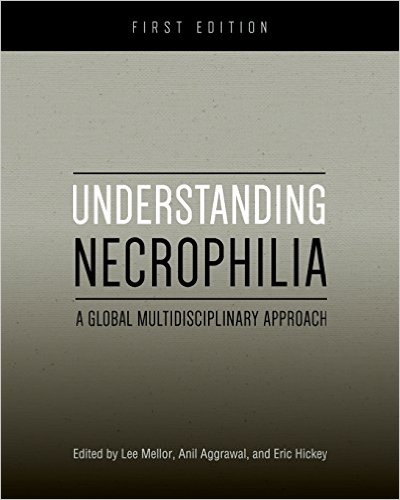
Steve Finbow’s book Grave Desire: A Cultural History of Necrophilia  is one that I wish I had known of while drafting my own chapter for Understanding Necrophilia: A Global Multidisciplinary Approach, however, it went under my radar during my initial lit review and subsequent revisions.

Finbow has a unique approach of moving seamlessly from real-life case studies to fictional narratives and back again, weaving them together with a variety of theoretical discourse. Because there is nothing to mark the transition between real and fictional examples (aside from consulting the end-notes), I foresee mishaps for rushed researchers. For example, a hapless undergraduateswriting a research paper and could easily misattribute a quote by fictional serial killer Patrick Bateman of American Psycho to Ted Bundy.

My favorite section of the book, and what would have been relevant to my chapter in Understanding Necrophilia, is Finbow’s discussiom of hyperrealism and simulacra in the context of the pornography use of necrophiliac serial killers Jeffrey Dahmer and Dennis Nilsen. Dahmer and Nilsen had remarkably similar behaviors in terms of pornography consumption, in their tendency to create homemade pornographic images their victims, and in their pattern of dismembering victims and using parts as masturbatory aids. Finbow observes:

…the object aethetized or eroticized is fundamentally dead, it has no being apart from its image, the image of and over which one masturbates, replacing the object with its copy…the body becoming rejectamenta, the person no longer, just something to be used and then to be disposed of. For Dahmer/Nilsen, living human beings were simulacra, they were copies of copies  of copies of objects of desire to be mut(il)ated into yet more copies until the subjects (torn, tattered, erased, decomposed) had to be disposed of, annihilated, or turned into things (p.133, Kindle edition).

As the passage above indicates, Grave Desire may not be reader-friendly for those unaccustomed to this type of academic writing, but I do recommend it for those interested in cultural theories of necrophilia.

A Carol for Another Christmas, Rod Serling's forgotten film

I confess…I haven’t been in much of a holiday spirit. And with a proliferation of reviews for popular Christmas movies such as Krampus, I didn’t feel compelled to add my own reviews to the mix. That said, I’m a sucker for Charles Dickens’ A Christmas Carol and for the many film adaptations of that story. Perversely, the Ghost of Christmas Future segment was always my favorite by virtue of being so grim.

Imagine my delight at discovering A Carol for Another Christmas on Turner Classic Movies earlier this month. This was a made-for-TV movie scripted by Rod Serling and released in 1964. This anti-war political modernization of the Dickens classic is grim in its entirety, with a message that is, unfortunately, still appropriate and timely.

In this version, an powerful industrialist Daniel Grudge coldly dismisses his nephew’s request to sponsor a cultural exchange program, instead adopting an isolationist political view. Like Scrooge, Grudge is visited by three spirits. In the past segment, he meets the ghosts of every soldier killed in every war in human history before meeting the disfigured survivors or Hiroshima. In the present segment, he is invited to a lavish feast but is forced to watch starving refugees in interment camps. When angered that he has to watch the suffering of the poor from other nations, the Ghost of Christmas Present reminds Grudge of his previous stance that providing aid to the poor prevents them from becoming self-reliant.

While the entire film is quite depressing, the future segment is, as usual, the “best” part. Grudge is shown the aftermath of a nuclear World War III, in which Peter Sellers portrays a demagogue known as the “Imperial ME,” dressed in a pilgrim costume and a cowboy hat cut to look like a crown. Sellers’ insane rants at the ruins of the town hall resemble Grudge’s own isolationist views taken to an extreme.

A Carol for another Christmas can be watched in it entirety at the Youtube link below, or purchased on DVD.

Review: Understanding Necrophilia

For this edition of Scary Scholarly Saturday, we are going to look at the anthology Understanding Necrophilia: A Global Multidisciplinary Approach, edited by Drs. Lee Mellor, Anil Aggrawal, and Eric Hickey. I’ll admit upfront that I’m biased in my review, because I authored the chapter “Objects of Desire: Necroeroticism in Mainstream Pornography.” I won’t go into detail about my own chapter (you can read the supplemental material here), other than to say that I did my best to ensure that I was the villain this anthology deserved. I’m so pleased and honored that my first print publication is in a collection alongside chapters by those listed above, as well as other personal heroes including Katherine Ramsland, Michael Stone, Louis B. Schlesinger, and my BFF Cody Charette.

In my (biased) opinion, there are no bad chapters in this book. Furthermore, this book is truly the first of its type, due to its multidisciplinary approach to the subject of necrophilia, which tends to be under-studied and under-reported. Many of us presented new research findings, or furthered existing discourse on the subject. I can’t discuss all of the chapters in depth, but will cover a few highlights.

Chapters are grouped by discipline and subject matter, including historical and legal issues, cultural aspects (including depictions in literature and popular culture), etiological models, forensic investigations and treatment, and case studies.

*In “A Wider Shade of Pale” and “Mincing Words,” Lee Mellor examines paraphilias associated with necrophilia. The most important being that he finally lays to rest (pun intended) the idiotic term “necrosadism,” which  has been used to describe acts of piqcuerism and mutilation committed against corpses, and replaces it with a far superior term, “necromutilophilia.”

*In “Laws Pertaining to Necrophilia in the United States,” Dr. Cody Charette conducted a thorough examination of individual state laws un the U.S., debunking some often-misreported laws in the process. It is true that some states have no laws on the books against necrophilia. What I found interesting was the fact that a handful of states have laws containing gendered language that would theoretically allow female necrophiliacs to operate without fear of prosecution.

*Necrosurrealist artist David Gough was commissioned to create a new portrait for this anthology. The resulting piece, Putrefying Venus, is quite stunning.

*Jens Foell and Christopher Patrick discuss brain imaging data of paraphiliacs in “A Neuroscientific Perspective on Morbid Paraphilias.” Unfortunately, there are no brain imaging studies of necrophiliacs specifically, but the authors present a thoughtful discussion of how the existing research applies.

*Anil Aggrawal revisits his proposed typologies of necrophilia, previously outlined in his book Necrophilia: Forensic and Medico-legal Aspects, another book worth reading. I expect his typology to become essential in discussions of necrophilia.

Lastly, I want to point out that Understanding Necrophilia isn’t just a collection of academics and professionals dissecting necrophilia from the outside. This anthology also features an essay by a self-proclaimed necrophile. As a side note though, in my personal observation, successful academics and professionals don’t necessarily stand at a distance from any perversion, if you get my meaning. More than a few of us understand perversions from the inside looking out. But the gesture of including such an essay is unique and further sets this book apart from typical academic anthologies. Understanding Necrophilia further departs from the typical academic publication in that it embraces the fringes of pop culture by its inclusion of a chapter co-authored by Robert Rhine, the creator of Girls and Corpses Magazine.


Love is Dead, and so is 2016

After a mild illness and a whole lot of work, I’m back! We will be bringing you reviews of Christmas-themed horror films and novels (be sure to check out our recent podcast) as the holidays draw near. But also, since 2016 is almost dead, it seems fitting to feature discussion of all things related to necrophilia. OK, it’s a bit self-serving as the book to which I contributed, Understanding Necrophilia: A Global Multidisciplinary Approach, is now in print.

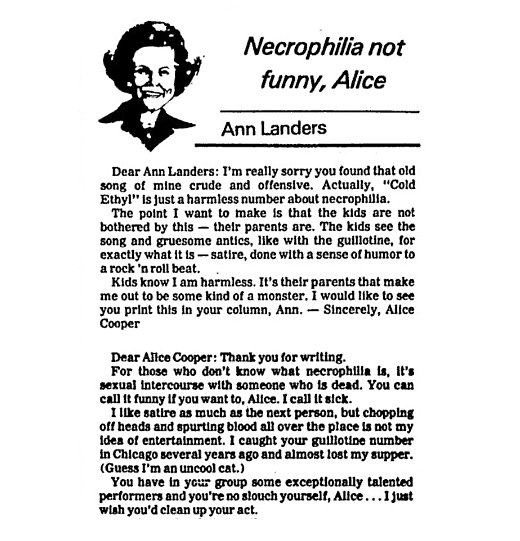
Come back tomorrow for a review of that book, but in the meantime, do you remember that time Alice Cooper and Ann Landers had an argument about his song “Cold Ethyl,” with Landers titling her column with the rebuke, “Necrophilia not funny, Alice”?

…Let’s agree to disagree, Ann.

Landers issues her complaint a few years after “Cold Ethyl” appeared on Cooper’s solo debut Welcome To My Nightmare. And it was not the first time Cooper recorded a song about necrophilia. “I Love the Dead” (performed live in the video below) was featured in the band’s 1973 album Billion Dollar Babies.

The Mary-El Tarot

For this month’s Disturbed Divination feature, I wanted to cover a Christmas or Yule-themed tarot deck. But since I have none in my collection, I’m opting instead to review The Mary-el Tarot: Landscapes of the Abyss, in which Biblical and apocalyptic imagery abounds. This is one of my favorite decks in my collection. Marie White’s cards are simply stunning, and come with an in-depth guidebook detailing each card’s symbolism.

fullsizeoutput_f26

She draws upon the Rider-Waite, Thoth, and Marseille decks with results simultaneously sacred and devilish. My favorite variation in this deck compared to other decks is that the Aces (beginnings) are represented by the Four Heavenly Creatures of the Bible and the 10’s (ending or completion of cycles) are represented by the Four Horsemen of the Apocalypse. It’s a morbid, yet appropriate, touch. The guidebook finds connections between Biblical, Pagan, Qabalistic, mythological, and pop culture concepts. Although somewhat unconventional, this deck is appropriate for beginners and for any tarot-lover.

Understanding Necrophilia now in print!

 I am pleased to announce that the book to which I contributed original research, Understanding Necrophilia: A Global Multidisciplinary Approach, is finally in print! This is the first time my work has been published in print, and I wasn’t prepared for the grueling (yet fun and challenging) process it would be. The creator of this meme below has the right idea.

manuscript-accepted-meme

Looking ahead, December at My Horrific Life will be both a month of creepy Christmas cheer and a month of necrophilia, as I’ll be posting a review of Understanding Necrophilia (as soon as my contributor copy arrives) and reviews of complementary books. Stay tuned for our December podcast episodes as Todd and I discuss my research and our favorite Christmas-themed horror entertainment.