John Carpenter's The Thing: Identity Crises

I have so much love for the films that comprise John Carpenter’s so-called apocalypse trilogy, but I am in the minority for loving In the Mouth of Madness the most of the three. In fact, I would posit that the entries in the series get progressively better due to increasingly complex and intriguing concepts. All three films feature Lovecraftian concepts to some degree. All three are also obsessed with the dissolution of personal identity. And all three films challenge popular notions of reality.

(Beware of spoilers ahead.)

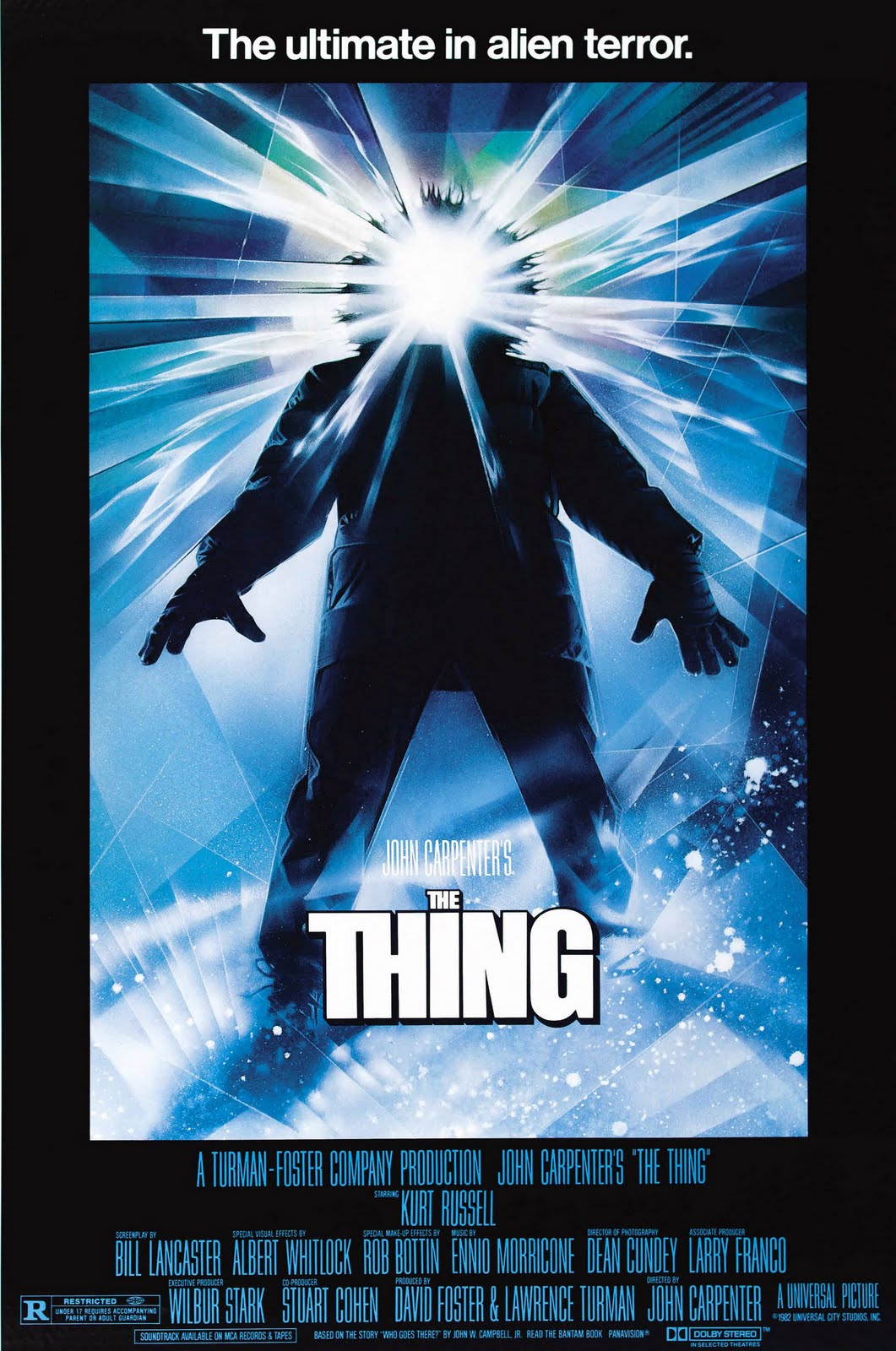
The first of the trilogy, The Thing, was full of fantastic special effects, but was still grounded in conventional science. Most people who are reading this blog already know that the Carpenter film was a remake of a 1951 film The Thing from Another World, which was in turn adapted from the John Campbell story Who Goes There?. In The Thing, an alien life form is able to “take over” our terrestrial life forms, replacing their cells with its own cells, and perfectly imitating the original life forms’ appearance, memories, and personality. Aside from mind-bending special effects, the creepy thing about this movie is that your friends may not be your friends. Even creepier, you  yourself may be a Thing and not even know it yet. Creepiest yet, if the Thing were able to replace all life on the planet, there would be one species constantly hunting and eating itself in its many forms, making life on earth a sort of grotesque biological recycling facility.

The “Thing” in the process of imitating a dog.

There are aspects of the Thing’s physiology and behavior that the characters can’t explain, but it’s clear that these things eventually could be explained by science. At the end, science and good-old-fashioned masculinity save the world from this stealthy form of alien takeover. Even though it’s implied that the two surviving characters will meet a bad end, it’s reassuring that the world is safe and order is restored.

As we’ll soon discuss over the next few days, this isn’t the case with Prince Of Darkness and In the Mouth of Madness.


Weirding the Apocalypse Part 2: Pontypool

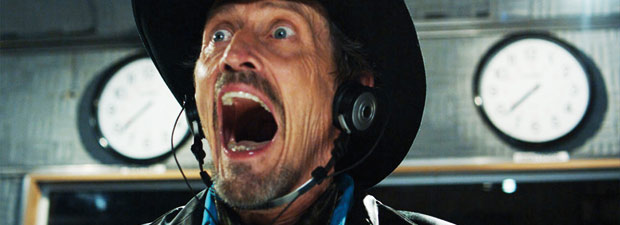
Based on the Tony Burgess novel Pontypool Changes Everything, the film Pontypool is a strange take on the zombie apocalypse narrative. Instead of a conventional contagion, the cause of the outbreak is a virus of language itself, with the English language and terms of endearment designated as especially dangerous. The afflicted begin to repeat words and nonsensical phrases before attacking and cannibalizing others. A doctor terms the disease Acquired Metastructural Pediculosis, and determines that the infection is caused by not merely hearing the infected words, but by speaking them and fully understanding their meaning. He also states that if the disease is left unchecked, it could threaten the fabric of reality itself. This would imply that language creates reality and not the other way around. While the doctor never explains this fully, it seems that some familiarity with semiotics and postmodern theory is useful when watching this film.

The strangeness of the film’s concept nearly overshadows the great performances by Stephen McHattie and Lisa Houle, respectively portraying ex-“shock jock” morning show DJ Grant Mazzy and his producer Sidney Briar. The radio show format is perfect for a story about language and understanding. There is very little on-screen violence and gore. Instead, most of the “action” is narrated to us by Mazzy and other radio personalities, based on briefings from law enforcement and calls from panicked citizens.

It had been several years since I first watched Pontypool, and have just now begun reading the novel, which is even weirder. Burgess uses a writing style that resembles the language of the infected, or the language of the cure as presented in the film adaptation. It’s also worth noting that Burgess himself adapted the novel to a screenplay. Pontypool Changes Everything is part of a loose trilogy of Burgess novels, also including The Hellmouths of Bewdley and Caesarea, available as a one-volume set The Bewdley Mayhem.


Weirding the Apocalypse Part 1: Carnosaur (1993)

Scoring only 3.5 out of 10 stars on IMDb and 11% fresh on Rotten Tomatoes, the 1993 Jurassic Park knock-off Carnosaur (directed by Adam Simon and produced by Roger Corman) doesn’t get a lot of love. Technically, it isn’t a knock-off, as it’s loosely based on a 1984 novel by John Brosnan  (a.k.a. Harry Adam Knight), which itself predates  Crichton’s novel.  But the timing of the film’s release was certainly meant to cash in on the success of Jurassic Park, and even adds an additional callback by casting Diane Ladd, mother of Jurassic Park‘s Laura Dern, as a mad scientist.

Carnosaur doesn’t boast the then-cutting edge special effects of Jurassic Park. In fact, the dinosaurs are overly rubbery and the film as a whole is incredibly low budget, but in other respects, Carnosaur is the weirder, gorier, and more tantalizing of the two films.

Let me explain.

Despite Jeff Goldbloom’s character in Jurassic Park being quite delicious as the resident pessimist, like all Spielberg movies, the entire film is very much Up With People in its outlook. It’s comfortably anthropocentric, with dinosaurs being genetically engineered for the sole purpose of humans’ entertainment and corporate profit. Of course things go badly, but order is ultimately restored with humanity reasserting itself as the dominant species.

Carnosaur also has a plot involving the creation of genetically engineered dinosaurs, but with a twisted motive. Dr. Jane Tiptree (portrayed by Diane Ladd) is a female mad scientist (a rarity in horror films), who has a strange plan to save the earth. She has created and introduced a food-borne virus into poultry products that recodes human DNA in such a way as to cause women to give birth to dinosaurs, killing the female host and thereby preventing the human race from reproducing. Dr. Tiptree wants humans to become extinct and to “give the earth back to the dinosaurs.” This is an absurd, even arguably idiotic apocalypse scenario. What makes it effective is Dr. Tiptree’s misanthropic philosophy.

Carnosaur isn’t the first film to depict and apocalypse in which humanity is supplanted by another species. Better-known and more popular examples include Invasion of the Body Snatchers (and its remakes) and John Carpenter’s The Thing. Those films depicted a quiet alien invasion in which the alien species can imitate other life-forms. They didn’t celebrate the extinction of the human race. Carnosaur is nastier by virtue of Jane Tiptree acting as a species-traitor who promotes misanthropic and anti-natalist perspectives, viewing humans as nothing but a “set of instructions for the reproduction of the species.”

She explains her reasoning: “Just imagine. An ugly cancerous grey planet littered with the dying remnants of biological life as we know it. I actively worked on that in industry and in government. The earth isn’t ours to destroy…I don’t want to end the world, just one unruly species…The human being is the WORST. The human species is a disaster.” Tiptree’s radical solution to save the earth and the environment even includes her own extermination after serving as a vessel for her new breed of dinosaurs. The end of the film is ambiguous. The hero obtains the serum needed to reverse the effects of the virus, but he may be too late to save the high percentage of people infected.

Happy New Year from My Horrific Life

While most people associate the New Year with new beginnings and seek to fully embrace life’s possibilities, we here at My Horrific Life are celebrating the eventual end of the human race, which may come sooner than we think. We won’t discriminate about the means to this end, as we delve into all manner of fictional, religious, and theoretical possibilities, including Biblically-inspired narratives, disease, nuclear war, climate change, zombie hordes, linguistic viruses, alien invasions, and a takeover by Lovecraft’s elder gods.

Stay tuned for reviews of apocalyptic and post-apocalyptic film and fiction, including a spotlight of John Carpenter’s so-called “apocalypse trilogy.”

A Carol for Another Christmas, Rod Serling's forgotten film

I confess…I haven’t been in much of a holiday spirit. And with a proliferation of reviews for popular Christmas movies such as Krampus, I didn’t feel compelled to add my own reviews to the mix. That said, I’m a sucker for Charles Dickens’ A Christmas Carol and for the many film adaptations of that story. Perversely, the Ghost of Christmas Future segment was always my favorite by virtue of being so grim.

Imagine my delight at discovering A Carol for Another Christmas on Turner Classic Movies earlier this month. This was a made-for-TV movie scripted by Rod Serling and released in 1964. This anti-war political modernization of the Dickens classic is grim in its entirety, with a message that is, unfortunately, still appropriate and timely.

In this version, an powerful industrialist Daniel Grudge coldly dismisses his nephew’s request to sponsor a cultural exchange program, instead adopting an isolationist political view. Like Scrooge, Grudge is visited by three spirits. In the past segment, he meets the ghosts of every soldier killed in every war in human history before meeting the disfigured survivors or Hiroshima. In the present segment, he is invited to a lavish feast but is forced to watch starving refugees in interment camps. When angered that he has to watch the suffering of the poor from other nations, the Ghost of Christmas Present reminds Grudge of his previous stance that providing aid to the poor prevents them from becoming self-reliant.

While the entire film is quite depressing, the future segment is, as usual, the “best” part. Grudge is shown the aftermath of a nuclear World War III, in which Peter Sellers portrays a demagogue known as the “Imperial ME,” dressed in a pilgrim costume and a cowboy hat cut to look like a crown. Sellers’ insane rants at the ruins of the town hall resemble Grudge’s own isolationist views taken to an extreme.

A Carol for another Christmas can be watched in it entirety at the Youtube link below, or purchased on DVD.

Boris Karloff Month Finale: Targets

targetsposter

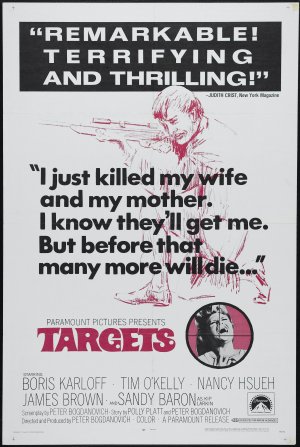
For this last day of November, it seems fitting to wrap up Boris Karloff Month by discussing Karloff’s last great film, Targets (1968), directed by Peter Bogdanovich.

Targets follows the story of two very different characters whose lives intersect by chance. The hero is Byron Orlok, portrayed by Karloff and clearly based on Karloff’s real-life persona. Orlok is an elderly horror star who is on the verge of retirement because he feels his brand of gothic horror is outdated, being replaced by the all-too-real horror of serial killers and mass murderers.

karloff-targets

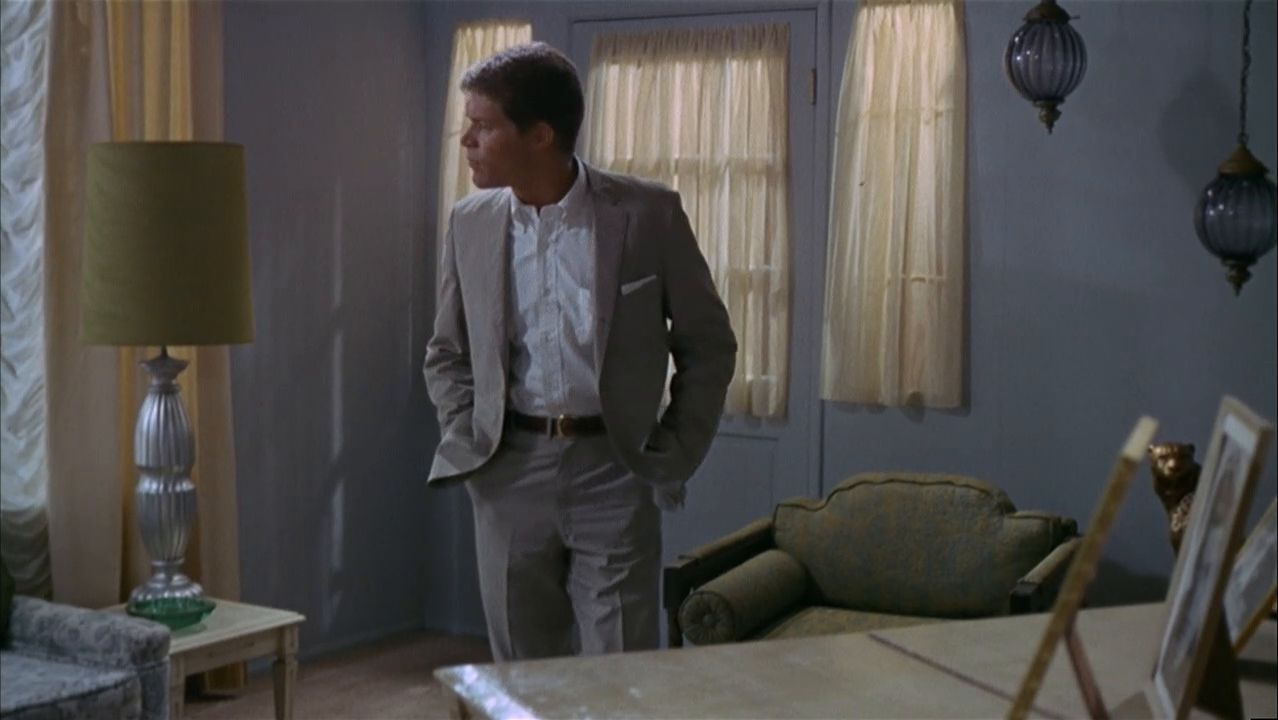
The other is Bobby Thompson, a young Vietnam veteran who superficially appears to be a clean-cut, productive suburban citizen (portrayed by Tim O’Kelly). Modeled after real-life University of Texas sniper Charles Whitman, Thompson buys several guns and large quantities of ammunition, murders his wife and mother, and then kills several strangers in sniper attacks. Thompson’s final shooting spree takes place at a drive-in theater where Byron Orlok is scheduled to give a final public appearance before retiring from acting.

targets-titlecard-388x220

The final confrontation between Orlok and Thompson is satisfying on a number of levels (beware of spoilers in this paragraph), beyond the simple enjoyment of seeing Karloff bitch-slap the young villain until he’s reduced to sniveling in fetal position. An optical illusion in which Thompson cannot differentiate between the two-dimensional screen image of Orlok and the real man advancing to disarm him may symbolize Thompson’s inability to differentiate his own twisted fantasies from reality. Orlok’s triumph may also signify that fictional horrors can serve as a protective factor against real-life horrors by exposing them for what they are. Having subdued Thompson, Orlok muses, “Is this what I was afraid of?”

While we can gain some insight into Charles Whitman’s motives through his journals, Thompson is a frustrating character because his motives are never explained. However, the contrast between Orlok and Thompson can also be examined in light of psychological theories of the time. In The Mask of Sanity: An Attempt to Clarify Some Issues about the So-Called Psychopathic Personality (1941) and its subsequent editions, Harvey M. Checkley argues that whereas many openly neurotic people are deeply good and loving at their core, psychopaths cause tremendous harm because they are able to effectively fit into societal norms. This argument perfectly parallels these characters. Orlok has made a career by nurturing the appearance of evil, albeit on a superficial level. In his personal life, he’s plagued by insecurity. Yet, at his core, he’s a kind and heroic person. In contrast, Thompson has only the appearance of goodness, trustworthiness, and normalcy masking terrifying schemes of destruction.

targets-1968-villain
The young villain and his sterile surroundings.

Erich Fromm’s theory of the necrophilous personality, first introduced in The Heart of Man: its Genius for Good and Evil (1964) and further detailed later in The Anatomy of Human Destructiveness , is also pertinent in explaining Thompson’s character. Fromm’s definition of necrophilia is not simply a sexual attraction to corpses, but an attraction to death and destruction for their own sake. Some of the features of character-rooted necrophilia include authoritarianism, the desire to tear apart living things, and fascination with all things mechanical (in this film evidenced by Thompson’s fetishization of guns). As with his inability to differentiate the two-dimensional screen image of Orlok with the man himself, it seems that Thompson doesn’t view his victims as real, or at least not as human. At one point he tells the gun store clerk that he’s going to “hunt some pigs.” Thompson’s use of firearms to dispatch his victims is cold, distant, clinical, and impersonal. This is visually represented by the icy hues and sterile surroundings in Thompson’s scenes. In contrast,  Orlok fits within Fromm’s description of the biophilous (life-loving) personality, reflected by the warm, earthy hues in his scenes. Orlok’s home is a bit more ornate, messy, and flawed…as he is. Extrapolate Orlok’s characteristics to the genre he represents, and again, there is an indication that the horror genre is on the side of life.

Boris Karloff month: The Black Room and The Walking Dead

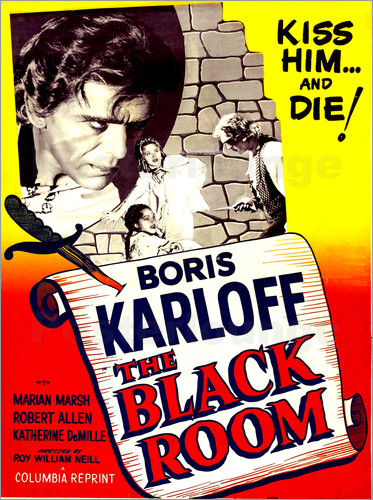
poster-the-black-room-us-1955-reissue-large-head-boris-karloff-scene-clockwise-from-right-boris-karloff-341054

Today, I want to briefly discuss two Boris Karloff films that I adore, but do not get much attention. Be advised, there are spoilers for both films ahead.

The Black Room (1935), is in some respects average and predictable, but it’s Karloff’s performance in a dual role that helps it shine. Karloff plays twins Gregor and Anton, both members of a European royal family in the late 1700’s. The great thing about this film is how it showcases Karloff’s acting range as the kindly twin Anton and the depraved twin Gregor.

karloff-black-room

While Gregor’s appearance is slightly disheveled, and Anton has a paralyzed arm, there are no significant differences in makeup effects for the two characters. The radical difference in demeanor is all due to Karloff’s versatility of performance. Although Anton is predictably murdered by Gregor at the halfway mark, it was great to watch Karloff in a kindhearted role that more closely mirrored his own personality. Some of Karloff’s other great scenes in the film are when Gregor assumes Anton’s identity, only to struggle with maintaining a facade of kindness as well as mimicking Anton’s disability.

The Black Room is available on DVD in the Boris Karloff Collection – 6 Movie Set: The Black Room, The Man They Could Not Hang, The Man With Nine Lives, Before I Hang, The Devil Commands, and The Boogie Man Will Get You.

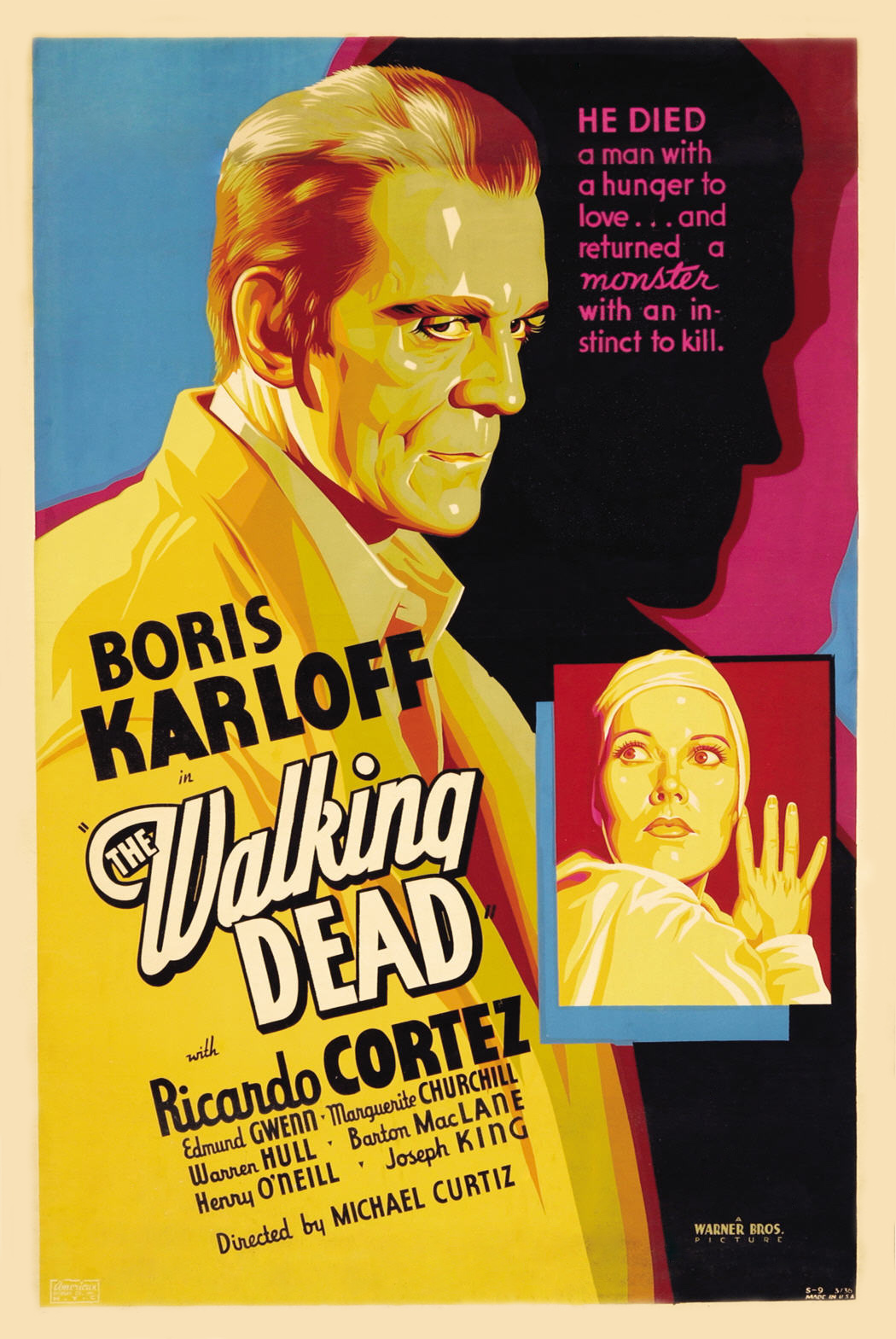
poster-walking-dead-the_02

The next film I want to discuss is The Walking Dead (1936), directed by Michael Curtiz. The Walking Dead is, in many ways, a ripoff of Frankenstein, but inverts the tropes of that film so extensively that the results are rather unique. Karloff portrays John Ellman, who is framed and wrongfully executed for murder. After being put to death by electric chair, Ellman is resurrected by a benevolent scientist who wishes to learn the secrets of the afterlife.

thewalkingdead_1936_ff_188x141_092220100543

Contrary to the salacious movie poster (see above), Karloff isn’t a bloodthirsty monster at all, but rather, a victim. Karloff’s performance is so effective because of his wonderfully expressive eyes, which bleed vulnerability. Like his character in Frankenstein, Karloff plays the role of monster-as-victim, with some important differences. Ellman retains his skills as a concert pianist and remains verbally articulate. He has a surprisingly sweet and gentle platonic friendship with the lead female character. And, most importantly, he doesn’t kill anyone. Ellman unwittingly becomes an agent of karma or of God’s judgement, because when confronts the men who framed him, they kill themselves. Each time, he is distressed to see them die and saddened that his own unjust death is never explained.

karloff-walking-dead

The Walking Dead is available as part of a 4-film DVD set, Karloff & Lugosi Horror Classics (The Walking Dead / Frankenstein 1970 / You’ll Find Out / Zombies on Broadway). This set is worth purchasing for this film alone and for the excellent commentary tracks on The Walking Dead and on Frankenstein 1970.

Horrific Homemaking: Classic Horror Film Coasters

img_5065

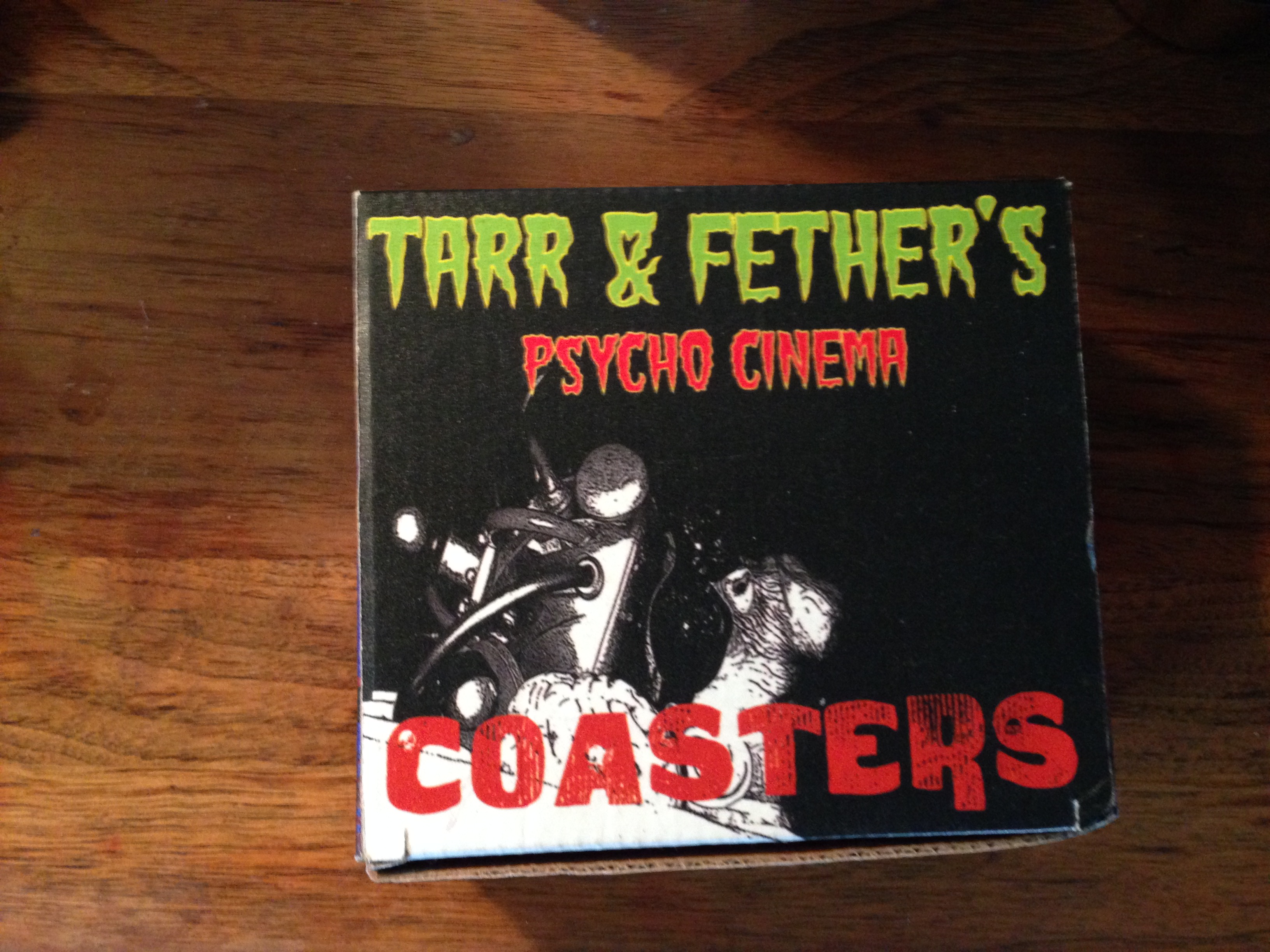
While at Horrorhound Indianapolis 2016, I met the guys from Tarr and Fether’s Psycho Cinema, and notice their series of cool 4-piece coaster sets based on classic movie posters. As you can see, I went with the set that reflected the work of my favorite actors Boris Karloff and Lon Chaney, among others.

img_5066

Unfortunately, I didn’t see a listing for other coaster sets at tarrandfether.com, but you may be able to inquire about purchasing a set there. Better yet, try to pick up a set  in person at one of their conventions!

Black Friday Special: Discounted Karloff Movies

black-friday-movie-poster-1949-1020192425

No, we aren’t actually selling any Karloff movies today. Rather, we are recognizing that Boris Karloff, like all great actors, starred in a number of films either not worthy of his talents, or films that were quite good but overlooked and discounted by critics and moviegoers alike. Coincidentally, many of these films are available for purchase at a bargain bin discount – often in a multi-movie set – through retailers such as Amazon.

I’ve personally decided to boycott Black Friday shopping in favor of revisiting these discounted Karloff films. It seems only appropriate to start this list with…

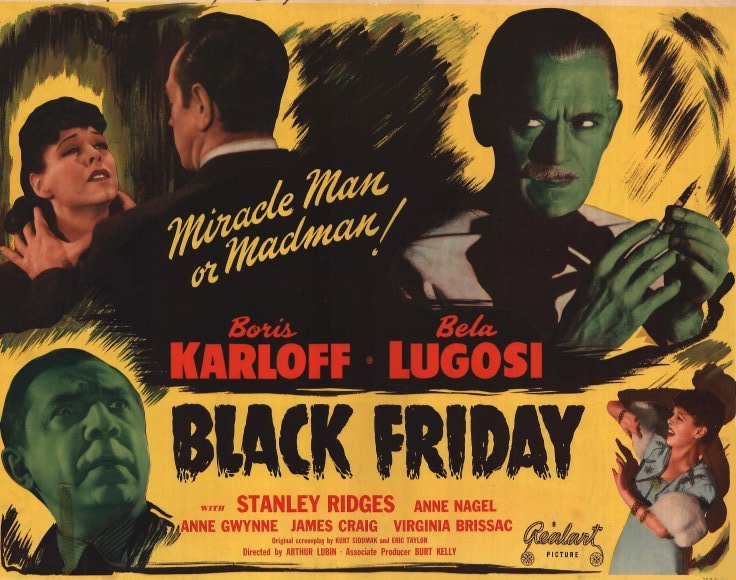
Black Friday (1940). Karloff plays a mad scientist who transplants the brain of a gangster into the body of a kindly professor. This is not done merely to see if it can be done, but because the gangster had access to a sizable sum of hidden cash which Karloff needs to fund his hospital and experiments. Where this film falls down for me is the fact that the brain recipient retains both the memories of the criminal and the professor, shuttling between the two in Jekyll and Hyde fashion. Even within the illogical nature of horror film logic, this was…illogical.

Frankenstein 1970 (1958). Karloff plays Dr. Frankenstein rather than the monster in this meta-ish 1950s reboot of the classic tale. Karloff’s character is working on a new Monster, which will be re-animated using atomic power. Things get complicated when he decides to allow a TV film crew to document his work. This film never breaks the 4th wall, but leans heavily against it. This movie isn’t as cool as it should have been, due to hammy performances and unintentionally funny moments in which Dr. Frankenstein bumbles and fumbles multiple sets of eyes intended for the Monster, necessitating the murder of multiple characters whose bodies get thrown into an oversized garbage disposal. The best part of this film is easily the commentary track on the DVD set Karloff & Lugosi Horror Classics (The Walking Dead / Frankenstein 1970 / You’ll Find Out / Zombies on Broadway)

The Climax (1944). This film had a great concept, with Boris Karloff in his first color film portraying a mad scientist who stalks an opera singer and attempts mind control experiments against her. There’s also implied necrophilia as he keeps the body of his former love object preserved in his chambers. Karloff has some great moments in this film, but like many 1940s movies, the plot frequently grinds to a halt to introduce a series of musical numbers. Worse, the musical numbers are not even true opera pieces, but instead a series of dated and forgettable songs performed by the heroine in shrill, yodeling soprano vocalizations. This is fine if you like 1940’s musicals, and the upshot is this movie featured some fun costumes and choreography. If it’s not your thing, fast forward through the musical numbers and shave off 50% of the viewing time.This is available, along with other films, in The Boris Karloff Collection (Tower of London / The Black Castle / The Climax / The Strange Door / Night Key)

Son of Frankenstein (1939). The was last time Karloff donned the makeup to reprise his role as the Monster for Universal Studios. Fans of Mel Brooks’ spoof Young Frankenstein  will recognize this as the source material for several funny scenes and characters. Son of Frankenstein is worth watching, even if lacks the weirdness and brilliance of Frankenstein and Bride of Frankenstein. My favorite thing about this film is actually the account of behind-the-scenes tickle wars between Karloff and other cast members, as described in Stephen Jacobs’ Karloff biography More Than a Monster.

You’ll Find Out (1940). Like stereotypical white girls everywhere, I can’t even. This movie wastes the talents of three great actors: Boris Karloff, Peter Lorre, and Bela Lugosi. This is a painful haunted house slapstick comedy punctuated by even more painful and unnecessary musical numbers. This is a movie I reference to illustrate that the 1940’s, along with the 1990’s, committed more crimes against the horror genre than all other decades combined. Avoid this unless you are a masochist or sincerely love 1940’s slapstick musical horror-comedies.

Abbott and Costello Meet the Killer, Boris Karloff (1949).As you can tell, 1940’s horror comedies are not my favorite, but there is some clever writing here, especially in the dialogue. For instance, the villain offers a character the choice of how he wants to die, and gets the response, “old age!” Despite the title, Karloff is actually not the killer. If you enjoy the comedy of Abbott and Costello, you will enjoy this.

Mr. Wong, Detective (1938). In this film and its sequels, Karloff dons “yellowface” to play the titular character. The upside is that, unlike his turn as Dr. Fu-Manchu, Karloff’s character is a positive, capable, and heroic character. This series is likely to be overlooked by horror fans, but is entirely worthwhile for those interested in crime dramas and murder mysteries.

The Night Key (1937). A solid crime drama in which Karloff plays a scientist who invents a cutting-edge security system and ends up being held hostage by criminals who want the key to crack his invention. Karloff’s character is a kind elderly man with failing eyesight, and it’s easy to empathize with his misfortune. This film is worth watching just to see the diversity of Karloff’s acting range apart from monsters and villains.

Given Karloff’s career in over 200 films and TV shows,  this list barely scratches the surface of his overlooked  and discounted films. Stay tuned for additional reviews of his work as November draws to a close.