My Horrific Weekend: Joe Bob Briggs, Get Out, and Vagina Monologues

I’ve been slow to write new posts because I had an overly long and horrific weekend. The most horrific event being seeing a live performance of the Vagina Monologues for the first time. Don’t get me wrong; the performers did a good job, but I didn’t relate to the source material…at all, although I did like the part where one woman states she viewed her vagina as a black hole, randomly sucking up random particles in its orbit. Perhaps the most disappointing part of the Vagina Monologues is the fact that no vaginas actually talk. I suppose this makes me a bad feminist. Even after over a decade of working with rape survivors, I’m tragically uncool for not “getting” the Vagina Monologues, and in general for not wanting to hear other women talk about their vaginas.

Before this horrific end to my horrific weekend, my podcast cohost Todd and I recorded an episode about sadomasochism in horror movies and why BDSM is boring in real life.  Then we went to see Jordan Peele’s new film Get Out . This is by far the best theatrical release movie I have seen in months. Todd and I will be discussing this film at length in our next podcast, so I won’t spoil too much here. That said, we went to our town’s opening night screening which had an unusually mixed race audience for a horror film in Nebraska. Based on the raucous cheering during the film’s final act, I can conclude that everyone enjoys seeing shitty white characters die. It goes to show that even white people are sick of white people’s bullshit. This movie may be the first step in healing the racial divide that is tearing our country apart. Take a look at the trailer below, and then get thyself to thy local multiplex immediately.

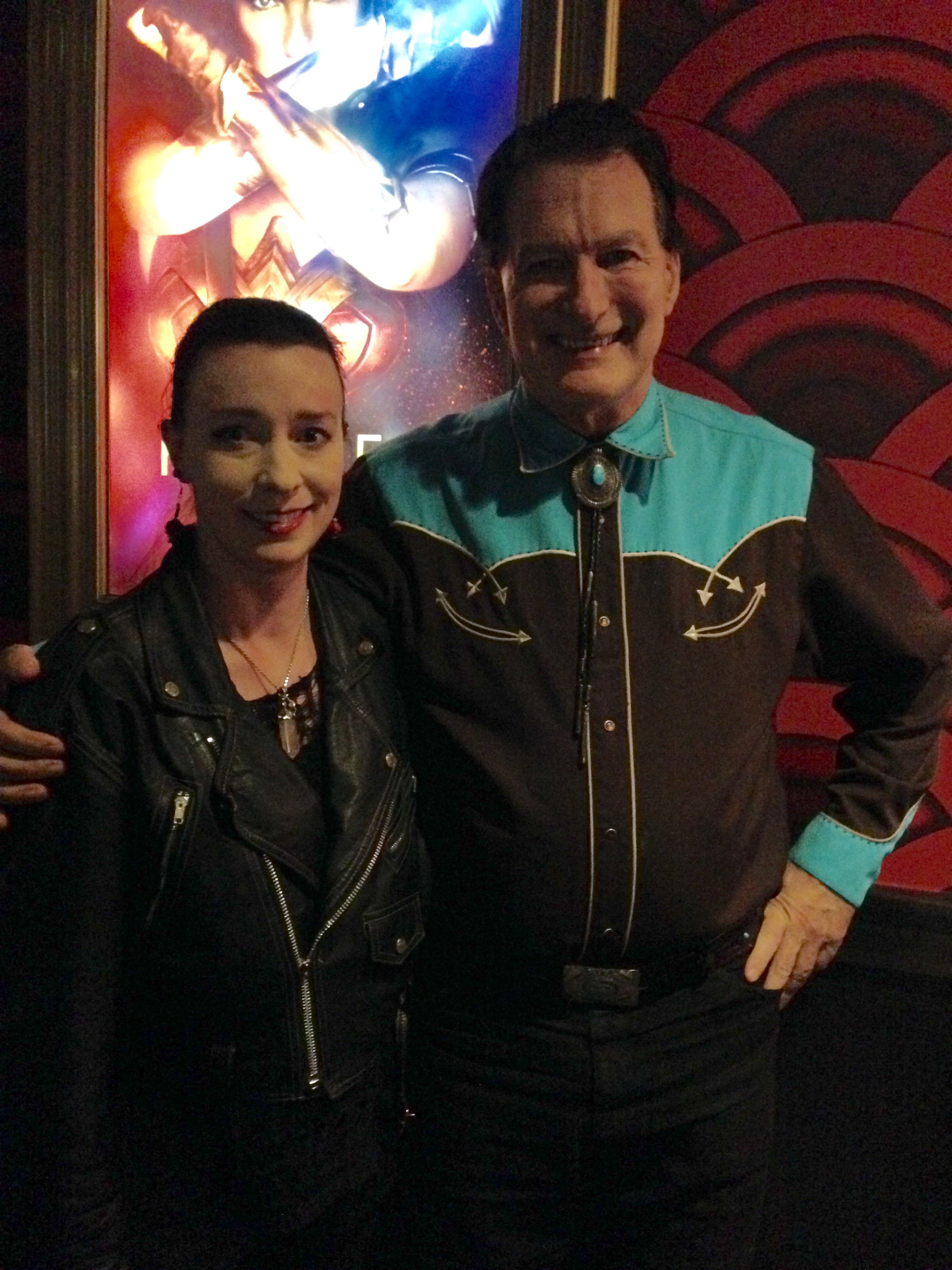
The highlight of my weekend was meeting Joe Bob Briggs, who had a guest appearance at the Alamo Drafthouse in La Vista, Nebraska for a special screening of David Lynch’s Blue Velvet Blu-ray Blue Velvet. I’ve loved Joe Bob since the 1990’s, when I discovered him on TNT’s Monstervision and then read his books. Many horror fans are familiar with Monstervision and Joe Bob’s column, compiled in Joe Bob Goes To the Drive-In, and with his tendency to anger people on the right and the left. Many people have been snowed by his redneck persona and don’t know that he has an Ivy League education. And many people didn’t appreciate the underlying intellectual approach to examining films other critics would prefer to ignore. I suspect that only hardcore fans are familiar with his work to expose fraudulent TV evangelists as a member of the Trinity Foundation and the Daily Show’s segment God Stuff.  The same goes for his “serious” nonfiction works written as John Bloom, most recently Eccentric Orbits: The Iridium Story.

Based on the sarcasm and caustic humor in his books and television persona, I expected Joe Bob to be the type of celebrity guest who roasts his fans. Actually, he was one of the nicest people I’ve met. Of course, I had to drag along copies of his books to be autographed. Joe Bob opened with facts about Blue Velvet, and followed the screening with a Q&A session. Blue Velvet was awesome on the big screen, but no one asked about it or wanted to debate the meaning of the film during the Q&A. Everyone had questions about Joe Bob’s career and which movies he found personally influential. One of the best pieces of advise was for reviewers and bloggers to move away from shallow write-ups of films and toward “curating” films instead. As he states in a recent interview, “You can watch even a horrible movie if you know enough about it in advance. A terrible movie, when it’s curated, can be fun. Certain things, if you keep them in the back of your mind, it changes your experience of the film, hopefully in a good way.”
 

Feed: "Consumption is Evolution"

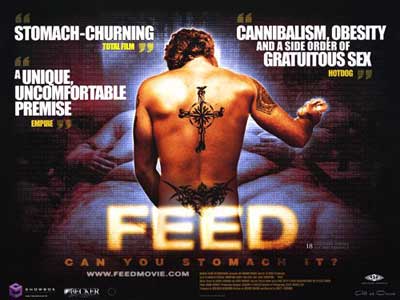
Keeping with the theme of kinky and anti-porn horror films, Love Object portrayed necrophilic fantasy, but the 2006 film Feed adds another layer of complexity to anti-porn rhetoric.  Feed addresses a bizarre spectrum of behaviors between consenting adults, opening with a scene based on the real-life case of the German cannibal Armin Meiwes, who placed an advertisement for a willing victim to be “slaughtered and consumed,” and found one. The Meiwes case has been depicted in other films, including Grimm Love (Fangoria Frightfest) Grimm Love and Marion Dora’s Cannibal. Feed and Cannibal are unconventional in their depiction of malevolent victims, That is to say, the “victims” not only consent to their demise, but are at least as culpable and villainous as the villains. The victim in Cannibal berates the Meiwes character into killing and eating him, suggesting that Meiwes initially merely fantasized about cannibalism but didn’t plan on following through. The victim in the beginning of feed is at least equally responsible, and pleads to the investigator who tries to save him, “It’s my body…and I want to be eaten!”
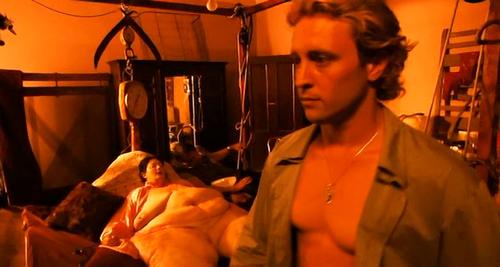
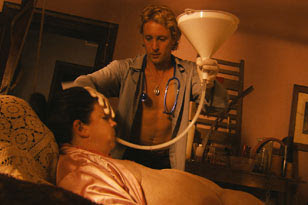
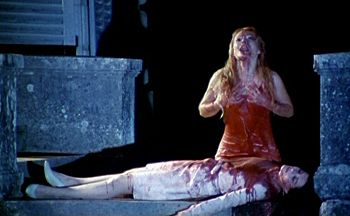
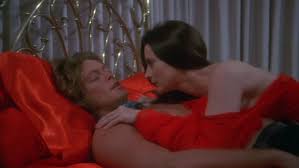
Deirdre is initially pampered in romantic surroundings…

It doesn’t seen that a film that starts with a man eating his own penis after watching it being fried in a skillet could get nastier, but it does. This film addresses an obscure subculture within the BDSM/fetish community (though many BDSM practitioners would disavow it), known as feeders and gainers, with a dash of vore. The gainer, usually a woman, is fed until she is so obese that she is completely dependent on her partner. Of course, numerous pornography websites are devoted to this paraphilia. The would-be hero of the film, Phillip, is an Interpol agent who investigates legal violations on “internet porn” sites. While investigating the fat appreciation fetish site, he discovers that the pornographer Michael is force-feeding the models to death. In an especially gruesome twist, subscribers to Michael’s site place bets as to how long it will take the women to die. Then, these women’s bodies literally become products to be consumed, as he feeds their fat to new, unsuspecting victims. When Phillip tries to save one of the models, Deirdre, who is near death, he is shocked when she rabidly defends her abuser.

…Then the boudoir devolves into an autopsy room as Deirdre nears terminal mass.

Although Feed addresses a very obscure subject, the overall message is that pornography “models” and sexual submissives are often so brainwashed that their consent cannot be considered genuine. The film depicts pornographers and dominants as merely preying on their submissives’ low self-esteem and creating the illusion of a caring relationship. The film’s villainous pornographer often adopts feminist rhetoric about healthy sexuality and body image, but in reality despises women. Michael tells heavy women that they are beautiful, and encourages them to gain more weight. His ideal of beauty becomes just as oppressive and destructive as the mainstream cultural mandate to be very thin. Perhaps this film is not fair to the feeder-gainer subculture, nor to BDSM subculture as a whole, but, based on personal conversations with various…people,  Michael’s rhetoric does resemble the twaddle spouted by some self-described doms…Beating the one you love is a way to honor them, blah blah blah. Suffice it to be said that the more I try to approach BDSM (or at least its apologists) with an open mind, the sillier–and more insulting–it seems.

Yet, this film poses important questions. Who decides what is safe, sane, and consensual? To what extent should we have freedom to decide the fate of our bodies? Are our desires really ours to begin with? Perhaps this is a conundrum because even the most “normal” and “healthy” sexual and romantic relationships are traditionally characterized and defined by the dominant/submissive binary.

(This post was adapted from an excerpt within my earlier work “Carnage and Carnality: Gender and Corporeality in the Modern Horror Film,” originally published in No Limits! A Journal of Women’s and Gender Studies, 2011, Vol.1.)

Love Object: pornographic fantasy as disease

Robert Parigi’s 2003 film Love Object is only one of many horror films that explore male fantasies involving passive women in the form of sex dolls and/or corpses. Other films to tackle the subject with varying degrees of competence include Dead Doll, The Coroner, Autopsy:Love Story, Marrionier: A Doll Horror Story, Living Doll, and the short film “Mail Order Bride” in Tales from the Carnal Morgue, Vol. One. As discussed in my essay within Understanding Necrophilia: A Global Multidisciplinary Approach, the sexual attraction toward dolls, statues, and mannequins is called pygmalionism, and is considered to be linked to necrophilia in that it provides an entirely compliant non-rejecting “partner.”
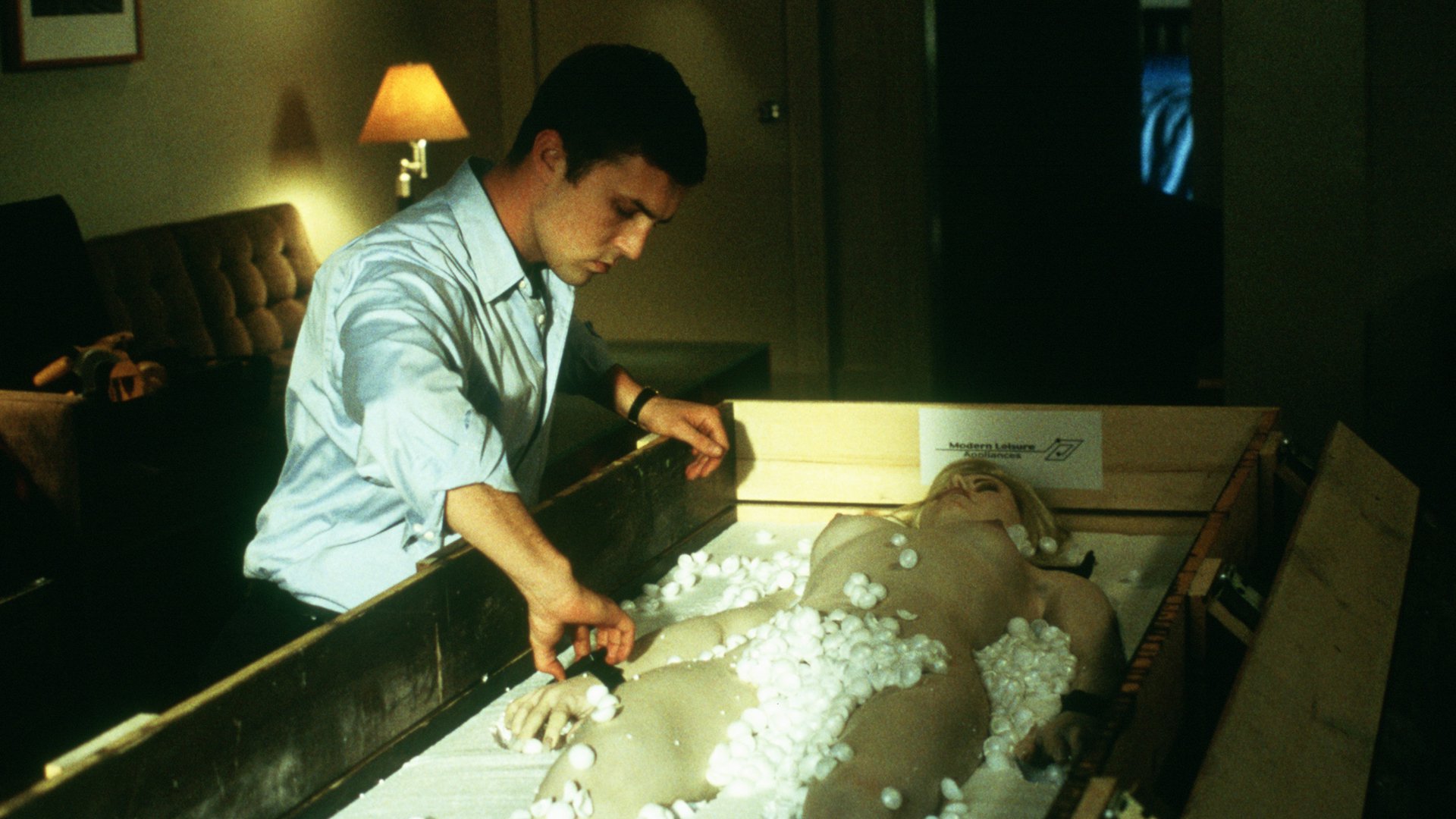

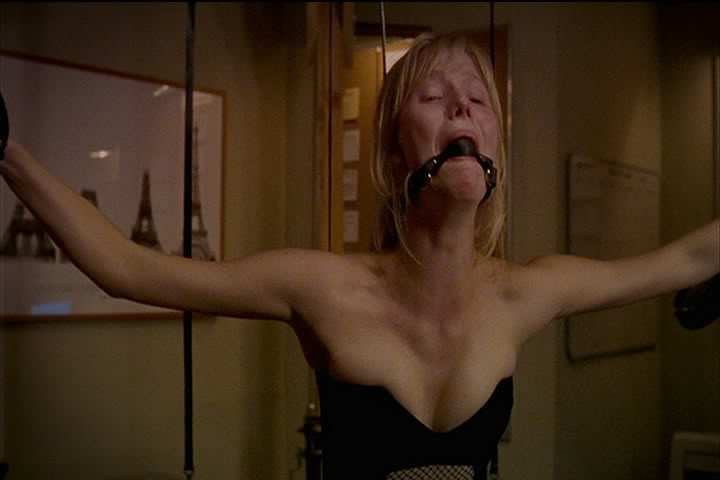
Kenneth unboxes his sex doll. Note the coffin-life appearance of the box.

Love Object is also one of many films that criticize the pornographic fallacy, that is, the phallocentric assumption that the desire of women is to fulfill the sexual desires of men, no matter how brutal or perverse. The feminist notion that pornography distorts men’s perceptions of women is illustrated by protagonist Kenneth’s visit to a porn shop, a scene that takes on a hallucinatory quality as he becomes increasingly entranced by the sight of silicone- enhanced, eager women and the prospect of sadistic and exotic sexual acts. But then there is a sharp jump-cut back to reality, which is a cruel shock—Kenneth is surrounded by real women, who are often dumpy-looking, pregnant, elderly, and/or generally disinterested in sex.

Kenneth shares a tender moment with his doll.

Kenneth is rather socially inept when it comes to relating to women. He has a crush on his coworker, but is unable to connect with her appropriately. He solves this problem by buying a $10,000 sex doll custom made in her likeness.  Initially, his role-plays with the doll help him “rehearse” appropriate interactions with his crush, who eventually dates him. However, he can’t handle the fact that his new girlfriend has a mind and desires of her own. His solution is to embalm her with a plasticizing agent so that she will be perfectly compliant, creating a necrophilic replacement for the original sex doll. The embalming plan doesn’t succeed, but depressingly, he gets away with his attempted crime because patriarchal society refuses to recognize that his desires are deviant.

Kenneth is less than tender with his flesh-and-blood girlfriend.

Love Object treats male violence against women as a continuum beginning in “harmless fantasy” that develops into objectification, and ends in femicide. To emphasize the pathological nature of the pornographic mentality, Parigi depicts it as manifesting itself as a disfiguring purple stain that marks the film’s perverts. The visit to the sex shop is the catalyst that transforms Kenneth’s personality. While extreme in its view that men are so easily influenced by pornography, it is merely an exaggerated version of Catharine MacKinnon’s theory that pornography “institutionalizes a sub-human, victimized, second-class status for women by conditioning orgasm to sex inequality,” (from Are Women Human?: And Other International Dialogues, hardcover first edition, p. 88), and that the pornographic mentality encourages men to experience women as compliant objects.
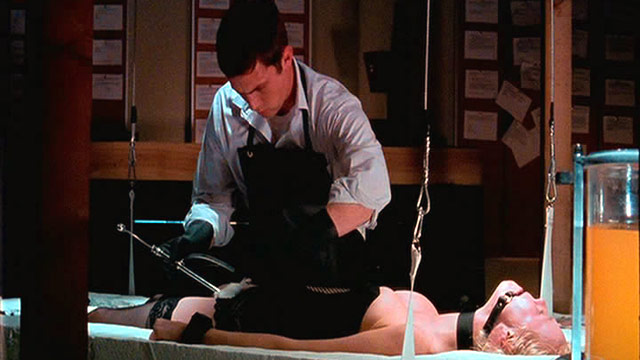
Kenneth attempts to embalm his girlfriend alive.

(This post was adapted from an excerpt within my earlier work “Carnage and Carnality: Gender and Corporeality in the Modern Horror Film,” originally published in No Limits! A Journal of Women’s and Gender Studies, 2011, Vol.1.)

Romance sucks: predatory sexuality in lesbian vampire films

I confess, I’m not the best person to review or analyze romantic horror films, or romantic anything. I tend to find the genre boring. But I can understand why it appeals to many readers, who want some sort of pleasant escape from the disappointments real life. In my observation, avid romance fans love the genre for providing a substitute for what they don’t have–a partner, or a partner who is sufficiently romantic and caring toward them. Be advised, I haven’t done any sort of formal study on this (I recommend you read this article by Janice Radway for an analysis of popular romance novels and their readers).

This isn’t to say that I’m negatively judging romance fans. Let’s face it, real-life romance is more often than not a dumpster-fire of drama. And Valentine’s Day season, with its emphasis on consumerism as a means of expressing heteronormative affection, is a hard time for many people. So why not embrace a fictional escape into a more perfect, more passionate relationship?

That said, I’m more interested in the worst-case-scenario, dumpster-fire depictions of romance than in idealized ones, and that cynicism is where the romance and horror genres can mesh well together.

Vampire Diane LeFanu corrupts the groom before dispatching him.

A case in point is the so-called lesbian vampire film of the 1970s. They are amazingly formulaic. Inevitably, they reference the Sheridan Le Fanu story Carmilla, and/or the crimes of real-life murderer Countess Elizabeth Bathory. In many cases a predatory lesbian or bisexual female vampire fixates on a newlywed heterosexual couple, and destroys their relationship from within. Among the films following this pattern are The Blood Spattered Bride, The Velvet Vampire, and Daughters of Darkness.

It’s rather challenging to analyze these movies, because they seem to close the gap between feminism and misogyny. If one assumes that they were marketed primarily to heterosexual men, as many horror and exploitation movies of the 1970s were, one can assume that these films are primarily misogynistic in their outlook. After all, during his honeymoon, his wife is seduced and snatched away by a woman with superior sexual prowess. In The Velvet Vampire, the vampire Diane LeFanu even tells the young bride that men hate and fear women, because women experience sexual pleasure that men can never understand. In most instances, the female vampires are cruel and predatory, and the young women are either neurotic or complete air-heads.

Newlywed Valarie is caught in the middle of two predators in Daughters of Darkness.

And yet, these films make their male heroes so incredibly unsympathetic, and in some cases, they don’t even survive the entirety of the film. The husband in Blood Spattered Bride rapes his wife and drags her around by her hair. Similarly, the husband in Daughters of Darkness is a sexual sadist who savagely and non-consensually whips his bride with his leather belt. Women, especially virginal women are forced with the awful choice of merely choosing the lesser of two abusers.

My Horrific Life gets kinky this February

Still from Jean Rollin’s Living Dead Girl

Now that we are abandoning January’s pleasant apocalypse fantasies, February will be devoted to something far more horrific: romance. In honor of Valentine’s Day and our corporate overlords who mandate that we purchase obligatory tokens of affection for those whom we love, we are kicking things off with our favorite romantic horror films and sexy vampire movies. Then as the romance wears off–as it always will–we will try to keep the spark alive by exploring horror that features kink, sadomasochism, and taboo sexuality.

As February is also Black History month, we will also be featuring reviews of race-related horror, including my current read Lovecraft Country: A Novel. We really can’t contain our excitement for Get Out, which looks something like The Stepford Wives, except subservience is  along racial, rather than gender lines.

Asmodexia's chiral apocalypse

As Apocalypse Month draws to a close, I’m going to plug an underrated and relatively unknown Spanish film, Asmodexia  (2014). It initially seems like any other exorcism/Biblical “end of days” movie, but then the ending ruins all of those preconceptions. This is not to say that clues were not embedded throughout the film or even in the title itself.

I’m going to spoil the ending for you.

The title “Asmodexia” is a portmanteau of “Asmodeus,” a king of demons in Judeo-Christian tradition, and “dexia,” the Greek word for “right-handed.” Right-handedness is associated in many cultures with righteousness. In occult terminology, there are “Right Hand Path” traditions and “Left Hand Path” traditions, the former being associated with blessings and seeking union with the divine, and the latter associated with curses and seeking the divine within (or glorifying the self). In organic chemistry, asymmetric molecules are considered right-handed or left-handed. “Chiral” molecules appear to be mirror-images of each other, identical in composition but opposite in handedness. The molecules necessary for life on Earth are more often than not left-handed. Chirality is occasionally a trope in fictional works such as Through the Looking-Glass or the “mirror universe in the Star Trek series, in which not only molecules are reversed, but morality and any number of social norms. So, perhaps the title implies that our left-handed world, in which Christianity is a dominant religion, is evil; and in the right-handed mirror world, Asmodeus/Satan is righteous. This is supported by protagonist Eloy’s references to mirror worlds and reverse scriptures.

If my logic seems tortured and obtuse, wait until you see the movie.

Just think of it as “every day is opposite day,” or “Alternative Facts: Religious Edition.” This is bound to take the offensiveness right out of it, at least for American evangelicals.

Jesting aside, other works have employed similar devices. The first that comes to mind is the C.S. Lewis classic The Screwtape Letters, in which characters frequently refer to “Our Father” and “The Evil One.” But since the reader knows up front that the characters are demons, it’s no surprise that the traditional meanings of these terms are reversed. By the end of Asmodexia, we learn that the father-daughter exorcist duo Eloy and Alba are not casting demons out of the afflicted, but rather exorcizing the indwelling of Jesus and the Holy Spirit from the bodies of ” heretics.” They journey across Spain to initiate Resurrection Day, in which Asmodeus will emerge as the savior of humanity. I confess, I did not entirely see the twist ending coming, because I’ve become so accustomed to films on the tradition of The Exorcist that I didn’t assume frequently-used terms such as “the Lord,” “Savior,” “unclean spirit,” and “Evil One” had meanings other than the norm for the sub-genre. One comment made during an exorcism seemed potentially Satanic, but I wrote the subtitle off as perhaps merely poorly translated from the Spanish dialogue. Yet, there was always something noticeably “off” about Eloy and Alba.
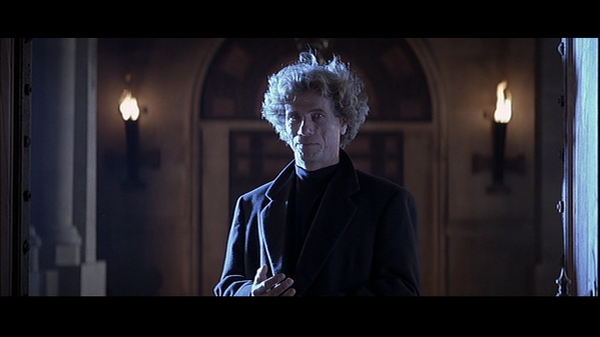
Because of similar themes, Asmodexia is a great movie to watch in conjunction with Prince of Darkness. While it hasn’t received the recognition it deserves, I hope it gains respect for its original twist on a worn-out subgenre. Asmodexia is currently available on Netflix’s streaming service and also on DVD.


In the Mouth of Madness (part 3): "You are what I write"

The Black Church is the gateway for humanity’s destruction.

In this final post on John Carpenter’s In the Mouth of Madness, I’m going to explore the film’s take on religion in general and Christianity in particular. I’m a bit surprised that the film has not drawn fire from Christian media watchdogs. Perhaps the film flew under the radar of most Christian viewers, but my Christian friends who have watched it don’t seem to regard it as particularly offensive.

In the Mouth of Madness makes a number of overt claims that would be regarded as heretical. In the church confessional booth scene, horror author turned deity Sutter Cane informs protagonist John Trent, ” Do you want to know the problem with places like this? With religion in general? It’s never known how to convey the anatomy of horror. Religion seeks discipline through fear, yet doesn’t understand the true nature of creation. No one’s ever believed it enough to make it real. The same cannot be said of my work.” He goes onto explain that his books have been translated into 18 languages and have sold over a billion copies. “More people believe in my work than believe in the Bible… It’ll make the world ready for the change. It takes its power from new readers and new believers. That’s the point. Belief! When people begin to lose their ability to know the difference between fantasy and reality the Old Ones can begin their journey back. The more people who believe, the faster the journey.” Later, Cane informs Trent, “I’m God now.”

Popular horror author and deity Sutter Cane

The idea that belief create reality is a subversive one, especially if that means that people create gods and not the other way around. It calls to mind occult theories of tulpas and thoughtforms.

What’s potentially more inflammatory than the overt text is the subtext. It became apparent to me–after many viewings–that In the Mouth of Madness is actually about Calvinism. And it presents one of the best arguments against Calvinism, at least if one has any investment in the belief in free will and in God’s inherent goodness.

For those unfamiliar with the term, it was named for the 1500’s theologian John Calvin, whose ideas were branded heretical by the Catholic Church. Calvin’s ideas still hold some weight among some Protestant denominations, though are hesitant to embrace all of its tenants. (Hence, you hear people describe themselves as four-point Calvinists as opposed to five-point Calvinists.) The big issue with Calvinism is that it opens a big can o’ worms regarding the nature of evil and whether God is good. Other forms of Christianity address these issues by stating that God is absolutely good, but evil exists because God allows his creations to have free will. Free will may be limited, because all people are born into sin and are incapable of absolute holiness, but people still have a great deal of freedom to make choices. In this model of Christianity, humans also have the free will to reject or accept the salvation offered by Jesus Christ. Therefore, God does not damn anyone to hell. Rather, some people elect to be sent there. It’s a decent explanation for why the world is so awful without besmirching God’s goodness.

In contrast, Calvinism posits that all of humanity is absolutely depraved and have no free will to avoid sinning, nor to freely accept or reject salvation. Instead, God “predestines” some for salvation and others for eternal damnation. (This is not the same as an all-knowing God knowing the outcome of every human choice before it happens.) Adherents who fail to see the nightmarishness of this have simply not followed the logic through to its natural conclusion. A belief in zero free will and in predestination cuts to the heart of any argument in God’s inherent goodness and justness. After all, how just and righteous is it to eternally damn a large segment of one’s own creation when they never had a choice to do wrong in the first place, nor the choice to reject an offer of salvation?  It seems that such a God would be damning people for the lulz, or as Calvinists would prefer to say, “for the good pleasure of His will.”

Trent takes a deeper look into the Word of God.

Trent protests, “God’s not a hack horror writer.” But a purely Calvinistic God surely would be. How else could one explain the entirety of human history, which reads like a long list of atrocities? Such an account only fits in the horror genre, and is nastier than anything conceived by even the most extreme writers. God would be an like an author who develops characters and scripts their every action in advance, writing out their ultimate ends in His infallible Word. His creations can consult his Word to see how it all turns out, but have no free will to exercise in the outcome. This is exactly what happens in In the Mouth of Madness, in which Cane, the Creator, does all of this with the added sadism of giving his creations consciousness and allowing them to labor under the illusion that they are real people who have a will of their own. Which is, I guess, also the same sadism present in Calvinism and other versions of theological determinism.

A funny meme (author unknown) offering a gentle reminder to anyone seeking to make anything great again.

Continuing the analogy of Sutter Cane as God, John Trent could be read as a perverse and inverted Christ, “the Word made Flesh.” This is where In the Mouth of Madness departs from Calvinism or any other form of Christianity, because Trent doesn’t deliver salvation to anyone. Rather, he is the unwitting and unwilling carrier of Cane’s “new Bible,” which will doom the entire human race. And for the people who don’t read, there’s a movie version.

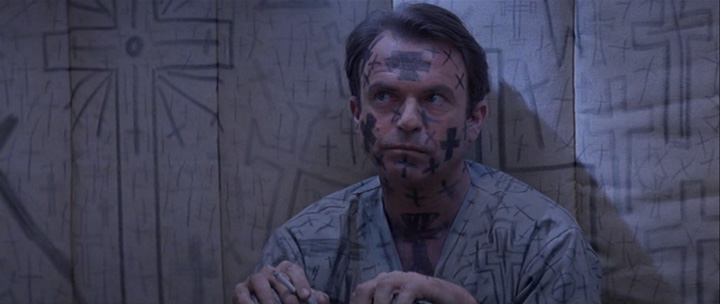
Trent adorned with and surrounded by crosses

Of course, not everyone takes offense at the notion of a sadistic puppeteer god who pulls the strings of creations who falsely believe they have a self, as we’ll see in my review of Thomas Ligotti’s Conspiracy Against the Human Race.


In the Mouth of Madness (part 2): "The sooner we're off the planet, the better"

In our last post, I discussed the various literary influences apparent in In the Mouth of Madness.  Today, I’m delving a bit deeper into some of the tropes and philosophies that informed Lovecraft’s work, and this film in turn.

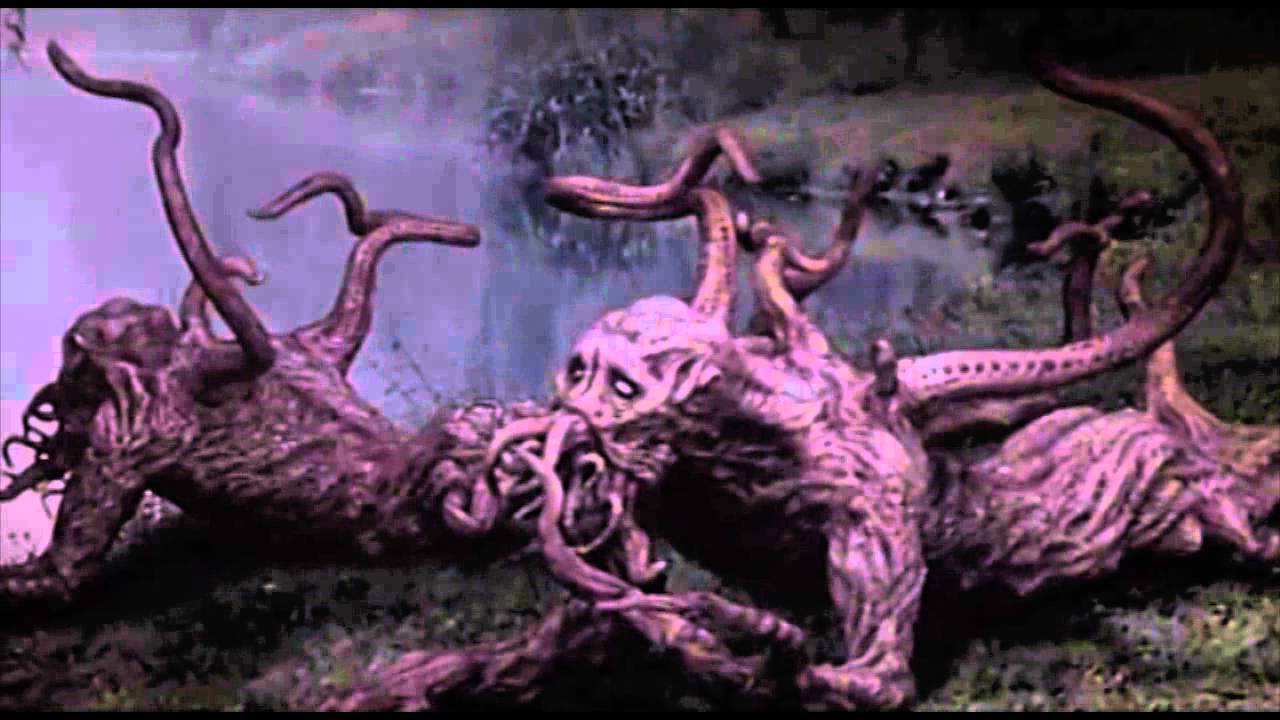
In the Mouth of Madness opens with John Trent being admitted to an insane asylum, where he recounts his story to an investigator (David Warren). One of the most common tropes in Lovecraft’s work is the notion that some truths are so terrible as to cause the knower to go insane. Consider this noteworthy opening quote from “The Call of Cthulhu”: “The most merciful thing in the world, I think, is the inability of the human mind to correlate all its contents. We live on a placid island of ignorance in the midst of black seas of infinity, and it was not meant that we should voyage far. The sciences, each straining in its own direction, have hitherto harmed us little; but some day the piecing together of dissociated knowledge will open up such terrifying vistas of reality, and of our frightful position therein, that we shall either go mad from the revelation or flee from the deadly light into the peace and safety of a new dark age.” In some Lovecraft stories, acquiring forbidden knowledge not only causes insanity, but forces bodily mutations upon the victim. This is apparently a trope within Sutter Cane’s fiction and also happens to unfortunate readers  of his newest novel, In the Mouth of Madness. In some respects, these mutations are reminiscent of transformation scenes in John Carpenter’s earlier film The Thing.

An ominous painting foretells the fate of residents of Hobb’s End

Misanthropy was rampant in Lovecraft’s fiction. In a letter to Edwin Baird, editor of Weird Tales, Lovecraft wrote of a young writer who wished to pen a story of a mad scientist who strives to conquer the world by unleashing a plague. To Lovecraft, this vision unoriginal and simply did not go far enough. “Good and evil, teleological illusion, sugary sentiment, anthropocentric psychology–the usual stock in trade, and all shot through with the eternal and inescapable commonplace…Who ever wrote a story from the point of view that man is a blemish on the cosmos, who ought to be eradicated?…I told my friend, he should conceive of a man with a morbid, frantic, shuddering hatred of the life-principle itself, who wishes to extirpate from the planet every trace of biological organism, animal and vegetable alike, including himself…Only a cynic can create horror–for behind every masterpiece of the sort must reside a demonic force that despises the human race and its illusions, longs to pull them to pieces and mock them” (Quoted in Thomas Ligotti’s The Conspiracy against the Human Race: A Contrivance of Horror) .This attitude is rampant in Sutter Cane’s work, and John Trent offers a similar opinion at one point when he tells Linda Styles, “The sooner we’re off the planter, the better.” However, Trent is ultimately unable to maintain that stance–or perhaps it was mere posturing all along–because he tries desperately to save humanity in the film’s final act.
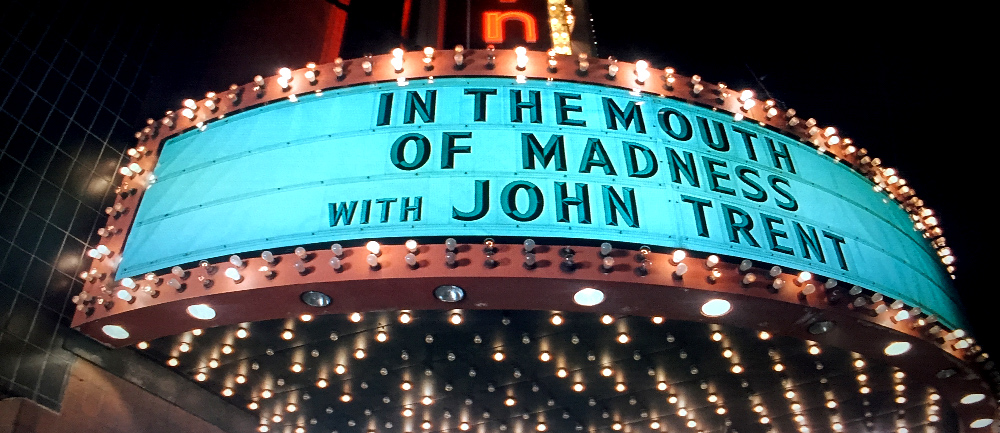
The last and perhaps most important Lovecraftian trope is identity-based horror. (And here I spoil the best scene in in the movie.) In “Through the Gates of the Silver Key,” Lovecraft writes, “No death, no doom, no anguish can arouse the surpassing despair which flows from a loss of identity.” Savvy viewers would know that John Trent is set up for such a fate, given his arrogance and frequent comments along the lines of “I’m my own man; nobody pulls my strings.” The revelation that he is not his own man and in fact has no free will is expected, but the specific nature of this revelation delivers a gut-punch arguably superior to similar twists penned by Lovecraft himself. In a confrontation with between Trent and Sutter Cane, Cane reveals, “This town didn’t exist before I wrote it, and neither did you…You are what I write!” Trent sputters and protests that he is not, in fact, a “piece of fiction,” Cane responds, “I think, therefore you are.” Trent is not even left with the solace of having once been human. He simply never was what he believed himself to be, and technically, was never real.

I will further discuss the notion human existence as puppet existence in our final post on In the Mouth of Madness and its religious implications, and in my review of Thomas Ligotti’s The Conspiracy Against the Human Race.

In the Mouth of Madness: "Reality is not what it used to be" (part 1)

Today we discuss In the Mouth of Madness, John Carpenter’s final entry in his so-called apocalypse trilogy. It’s also my favorite of the three films. It has layers of complexity that allow for multiple viewings. As a result, I decided to break up my commentary for this film over multiple entries. Be advised that I will be spoiling every major plot point and trope in this film. But, I will be discussing aspects of the film that aren’t generally known or discussed.

In the Mouth of Madness is a 1990s meta-horror film about an insurance fraud investigator John Trent (Sam Neill) who is hired by a major publishing house to find missing author Sutter Cane, and deliver his newest manuscript, In the Mouth of Madness, for publication. It’s a big deal because Cane outsells all others.

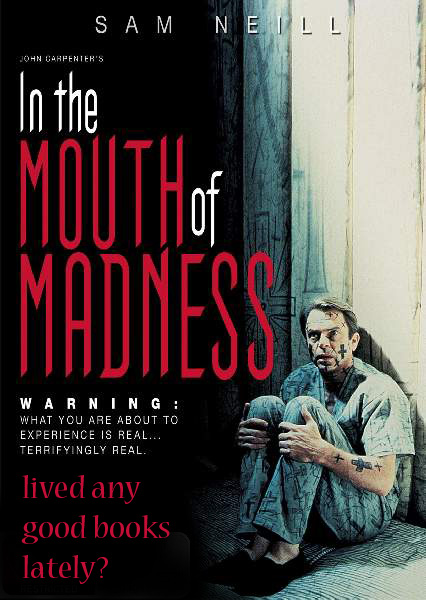
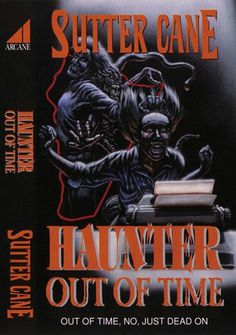
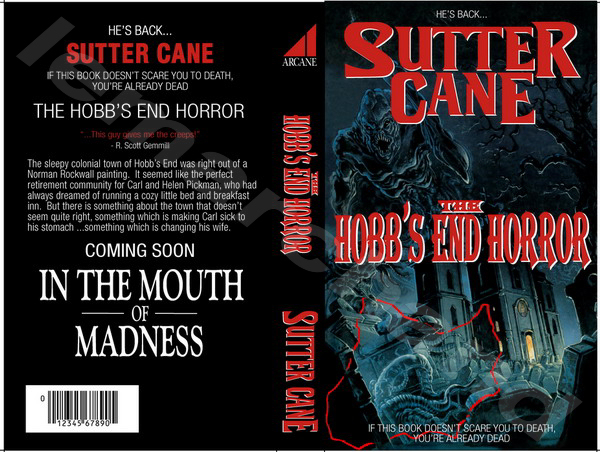
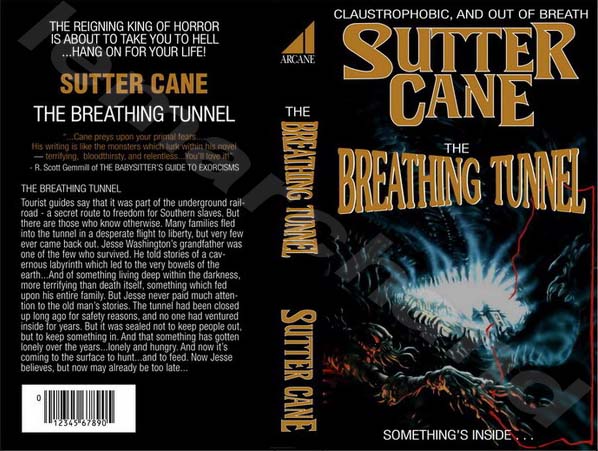
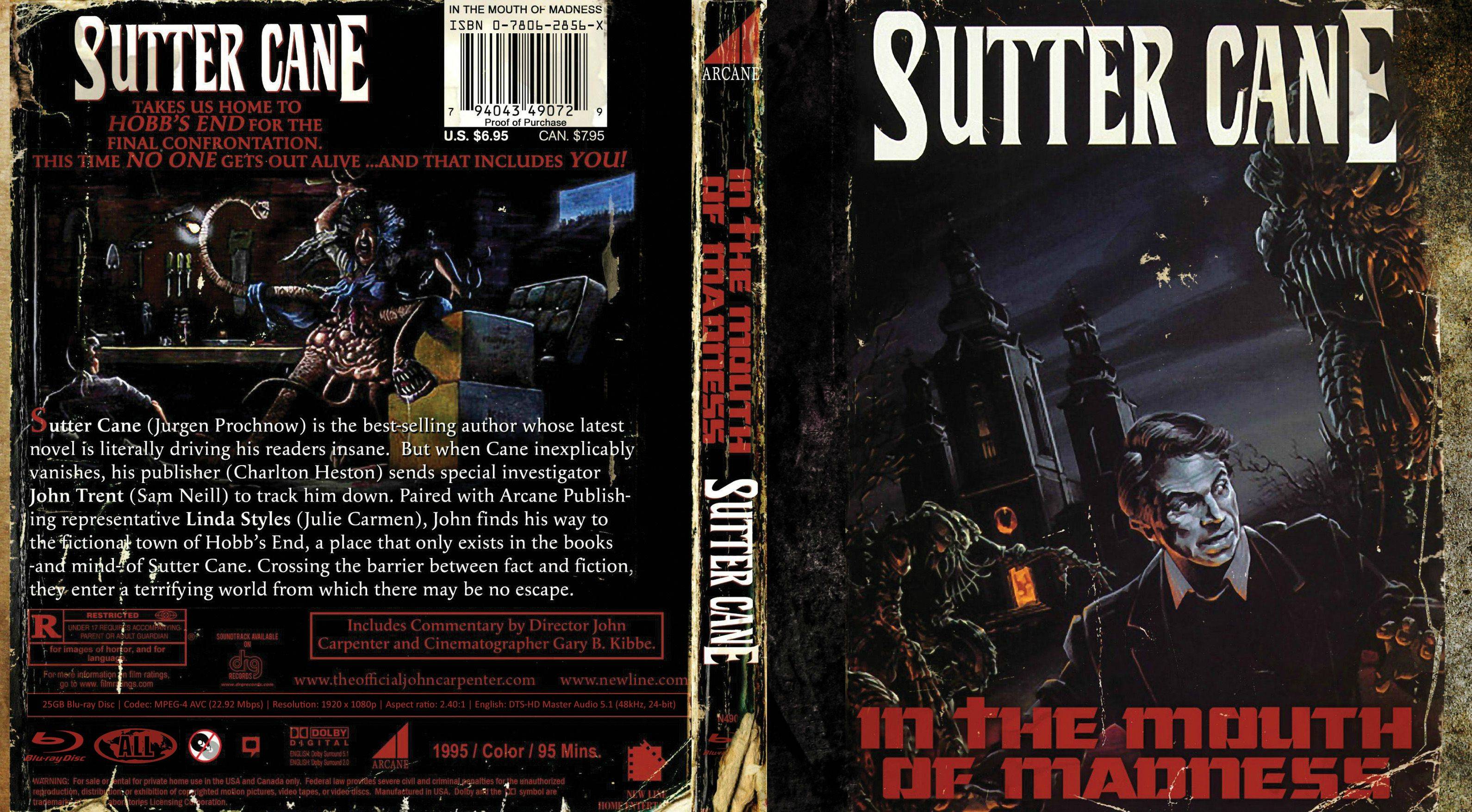
With a name like Sutter Cane, it may seem that he is based on Stephen King. However, it’s quickly apparent that he is actually modeled primarily on H.P. Lovecraft. As you can see from the covers below, and others glimpsed in the film, the titles are derivative of Lovecraft titles, including “At the Mountains of Madness,” “The Thing on the Doorstep,” “The Whisperer in the Darkness,” “The Color out of Space,” and “The Shadow Out of Time.”

Excerpts of Cane’s writing are distinctly Lovecraftian: “Trent stood at the edge of the rip, stared into the illimitable gulf of the unknown, the Stygian world yawning blackly beyond. Trent’s eyes refused to close, he did not shriek, but the hideous unholy abominations shrieked for him, as in the same second he saw them spill and tumble upward out of an enormous carrion black pit, choked with the gleaming white bones of countless unhallowed centuries. He began to back away from the rip as the army of unspeakable figures, twilit by the glow from the bottomless pit, came pouring at him towards our world…”

That said, many viewers may not recognize that this film borrows concepts from a ’90’s meta-horror short story collection…An 1890’s meta-horror story collection, that is. Robert W. Chambers’ The King in Yellow was published in 1895 and influenced Lovecraft’s own mythos. The King in Yellow is a collection of interconnected short stories about a book called The King in Yellow which is a best-seller that spreads “like an infectious disease.” Consider the excerpt below from “The Repairer of Reputations”:
“When the French government seized the translated copies which had just arrived in Paris, London, of course, became eager to read it. It is well known how the book spread like an infectious disease, from city to city, from continent to continent, barred out here, confiscated there, denounced by press and pulpit, censured even by the most advanced of literary anarchists. No definite principles had been violated in those wicked pages, no doctrine promulgated, no convictions outraged. It could not be judged by any known standard, yet, although it was acknowledged that the supreme note of art had been struck in The King in Yellow, all felt that human nature could not bear the strain nor thrive on words in which the essence of purest poison lurked. The very banality and innocence of the first act only allowed the blow to fall afterwards with more awful effect.”

As with In the Mouth of Madness, characters who read The King in Yellow go insane, become convinced they are characters in the book, and meet a variety of nasty ends. One of the characters in The King in Yellow is even named J. Trent. Adding an additional layer of complexity, The King in Yellow borrows concepts and characters from Can Such Things Be? by Ambrose Bierce.

When watching this film, there are a few ways to interpret it. One is that the book is a type of mind-virus, and everyone who believes it becomes convinced that they are characters in the book. Another is that Sutter Cane has indeed been promoted to a god-role and can write reality as he wishes. Or as Cane’s editor Linda Styles states, “What scares me about Cane’s work is what might happen if reality shared his point of view…Reality is just what we tell each other it is. Sane and insane could easily switch places if the insane were to become a majority. You would find yourself locked in a padded cell, wondering what happened to the world.”

In the next posts, I’ll discuss the film’s relationship to other Lovecraft tropes and its religious implications.


John Carpenter's Prince of Darkness: "Logic collapses on the sub-atomic level"

Today we discuss the second installment of John Carpenter’s “apocalypse trilogy,” Prince Of Darkness, perhaps one of Carpenter’s most misunderstood and criminally underrated films. It’s also daring by virtue of using concepts of quantum physics as the glue combining Christianity and aspects of Lovecraft’s Cthulhu Mythos.

As discussed in my last post, the first installment in the trilogy, The Thing, was ultimately reassuring. Because of a basic scientific understanding of the threat, order could be restored and a stealthy apocalypse avoided. Prince of Darkness undermines both science religion, institutions that provide comforting explanations for the nature of the universe and our place in it. This is explicitly discussed in the film, during Dr. Edward Birack’s lecture. “From Job’s friends insisting that the good are rewarded and the wicked punished, to the scientists of the 1930’s proving to their horror the theorem that not everything can be proved, we’ve sought to impose order on the universe. But we’ve discovered something very surprising: while order DOES exist in the universe, it is not at all what we had in mind!” However, at the start of the film, we learn that both religion and science are under threat, respectively due to suppressing aspects of reality and failing to understand it completely.

A church holds the future end of humanity

The instability of reality is also addressed in Professor Birack’s opening lecture: “Let’s talk about our beliefs, and what we can learn about them. We believe nature is solid, and time a constant. Matter has substance and time a direction. There is truth in flesh and the solid ground…. None of this is true! Say goodbye to classical reality, because our logic collapses on the subatomic level… into ghosts and shadows.” The uncanny and seemingly illogical discoveries of quantum physics open up the possibility of science acknowledging the validity of religion. The film’s surrealistic special effects support this theme, defying logic and the laws of Newtonian physics.

When  a Catholic priest requests that Birack and his graduate students study a mysterious container in a church basement, their findings undermine orthodox Christianity as well. Birack provides a radical proposal to the Priest: “Suppose what your faith has said is essentially correct. Suppose there is a universal mind controlling everything, a god willing the behavior of every subatomic particle. Well, every particle has an anti-particle, its mirror image, its negative side. Maybe this universal mind resides in the mirror image instead of in our universe as we wanted to believe. Maybe he’s anti-god, bringing darkness instead of light.” Prince of Darkness is not the first work to contemplate a parallel and opposite universe. I’ll discuss chiral and mirror-image words further in future posts. What’s unsettling here is that the evil world, ruled by Satan or anti-God is in fact the “normal” or default reality. In this instance, our world is the aberration that needs to be corrected or stamped out. The concept of the mirror world is revisited repeatedly when possessed characters attempt to use mirror as gateways into this other universe.

A possessed woman reaches into the other side of the mirror.

In case you find this view of religion intriguing and are wondering where Jesus fits into this, a document  concealed by the Church reveals that He was a benevolent extraterrestrial. This point is never mentioned again.

In the end, neither science nor religion can provide refuge for humanity. As the evil force warns a scientist via her computer screen, ” The Holy Ghost won’t save you. The god plutonium won’t save you. In fact…YOU WILL NOT BE SAVED!” As with The Thing, humanity is saved at the end, but the victory is only temporary. A vision of the future reveals that evil will merely wear a new face.

In our next post, we will contemplate how the apocalypse could be started by something as benign as popular fiction.