I am pleased to announce that the book to which I contributed original research, Understanding Necrophilia: A Global Multidisciplinary Approach, is finally in print! This is the first time my work has been published in print, and I wasn’t prepared for the grueling (yet fun and challenging) process it would be. The creator of this meme below has the right idea.
Looking ahead, December at My Horrific Life will be both a month of creepy Christmas cheer and a month of necrophilia, as I’ll be posting a review of Understanding Necrophilia (as soon as my contributor copy arrives) and reviews of complementary books. Stay tuned for our December podcast episodes as Todd and I discuss my research and our favorite Christmas-themed horror entertainment.
For this last day of November, it seems fitting to wrap up Boris Karloff Month by discussing Karloff’s last great film, Targets(1968), directed by Peter Bogdanovich.
Targets follows the story of two very different characters whose lives intersect by chance. The hero is Byron Orlok, portrayed by Karloff and clearly based on Karloff’s real-life persona. Orlok is an elderly horror star who is on the verge of retirement because he feels his brand of gothic horror is outdated, being replaced by the all-too-real horror of serial killers and mass murderers.
The other is Bobby Thompson, a young Vietnam veteran who superficially appears to be a clean-cut, productive suburban citizen (portrayed by Tim O’Kelly). Modeled after real-life University of Texas sniper Charles Whitman, Thompson buys several guns and large quantities of ammunition, murders his wife and mother, and then kills several strangers in sniper attacks. Thompson’s final shooting spree takes place at a drive-in theater where Byron Orlok is scheduled to give a final public appearance before retiring from acting.
The final confrontation between Orlok and Thompson is satisfying on a number of levels (beware of spoilers in this paragraph), beyond the simple enjoyment of seeing Karloff bitch-slap the young villain until he’s reduced to sniveling in fetal position. An optical illusion in which Thompson cannot differentiate between the two-dimensional screen image of Orlok and the real man advancing to disarm him may symbolize Thompson’s inability to differentiate his own twisted fantasies from reality. Orlok’s triumph may also signify that fictional horrors can serve as a protective factor against real-life horrors by exposing them for what they are. Having subdued Thompson, Orlok muses, “Is this what I was afraid of?”
While we can gain some insight into Charles Whitman’s motives through his journals, Thompson is a frustrating character because his motives are never explained. However, the contrast between Orlok and Thompson can also be examined in light of psychological theories of the time. In The Mask of Sanity: An Attempt to Clarify Some Issues about the So-Called Psychopathic Personality(1941) and its subsequent editions, Harvey M. Checkley argues that whereas many openly neurotic people are deeply good and loving at their core, psychopaths cause tremendous harm because they are able to effectively fit into societal norms. This argument perfectly parallels these characters. Orlok has made a career by nurturing the appearance of evil, albeit on a superficial level. In his personal life, he’s plagued by insecurity. Yet, at his core, he’s a kind and heroic person. In contrast, Thompson has only the appearance of goodness, trustworthiness, and normalcy masking terrifying schemes of destruction.
The young villain and his sterile surroundings.
Erich Fromm’s theory of the necrophilous personality, first introduced in The Heart of Man: its Genius for Good and Evil(1964)and further detailed later inThe Anatomy of Human Destructiveness , is also pertinent in explaining Thompson’s character. Fromm’s definition of necrophilia is not simply a sexual attraction to corpses, but an attraction to death and destruction for their own sake. Some of the features of character-rooted necrophilia include authoritarianism, the desire to tear apart living things, and fascination with all things mechanical (in this film evidenced by Thompson’s fetishization of guns). As with his inability to differentiate the two-dimensional screen image of Orlok with the man himself, it seems that Thompson doesn’t view his victims as real, or at least not as human. At one point he tells the gun store clerk that he’s going to “hunt some pigs.” Thompson’s use of firearms to dispatch his victims is cold, distant, clinical, and impersonal. This is visually represented by the icy hues and sterile surroundings in Thompson’s scenes. In contrast, Orlok fits within Fromm’s description of the biophilous (life-loving) personality, reflected by the warm, earthy hues in his scenes. Orlok’s home is a bit more ornate, messy, and flawed…as he is. Extrapolate Orlok’s characteristics to the genre he represents, and again, there is an indication that the horror genre is on the side of life.
Today is Boris Karloff’s birthday, so it seems fitting to dedicate this post to his life, and to extend happy birthday wishes to his daughter Sara Jane Karloff who shares his November 23rd birthday.
I confess that I knew very little about Boris Karloff as a person before beginning this blog, but exploring his life has been a beautiful, inspiring journey. The first biography that I read was Dear Boris: The Life of William Henry Pratt a.k.a. Boris Karloff by Cynthia Lindsay, who was a friend of Karloff’s for many years. Lindsay’s book is entirely worth reading, as she provides some wonderful insights into Karloff as a kind and devoted friend. But her book raises as many questions as it answers. Despite having been his friend for decades, there were many things that Cynthia did not know about Karloff’s life due to the fact he was a vey private person. Despite her best efforts at research, there were many details she simply could not uncover. Some of these details I found mysterious and unnerving. For example, he never discussed his childhood and revealed his five marriages after many years of friendship. I wonder if , in this era in which people share minute details of their lives on social media, people would regard Karloff’s secrecy about his private life with suspicion. Perhaps such discretion regarding personal matters is a lost virtue.
The next book on the list was Boris Karloff: A Gentleman’s Life Scott Allen Nollen. The author was able to consult with Karloff’s daughter, Sara, resulting in a more detailed account of Karloff’s life. My only complaint about this book is that the print is surprisingly small and there is no ebook edition. But if one can overlook the irksome font, this is a delightful book that gives great insight into Karloff’s character.
Boris with his daughter, Sara Jane, who shares his birthday.
Lastly, there’s Boris Karloff: More Than A Monster by Stephen Jacobs. This is, perhaps, THE authoritative text on Karloff’s life. I admit that I have not finished reading it yet, as it is over 500 pages long. What I’ve read is absolutely engrossing, as Jacobs was able to obtain previously unpublished material, including family letters. (However, what I’ve read so far does not shed much light on his five marriages.) I highly recommend this book, but am sad to report that it appears to be out of print and it is difficult to obtain affordable copies. Currently, the best and least expensive way to obtain a copy is directly thought Karloff.com, the official site maintained by Sara Karloff and other relatives.
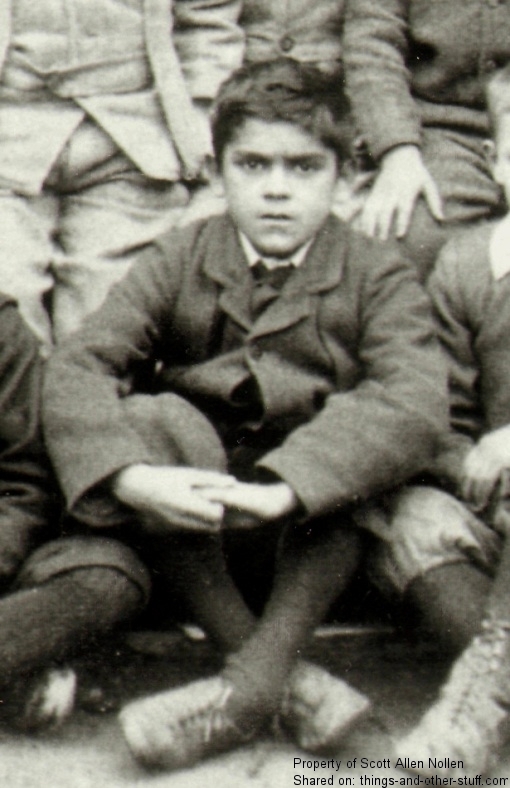
Boris as a child
Obviously, there is no way to summarize these three biographies, so I’ll just share a series of interesting and inspiring facts about Boris Karloff’s life and personality.
Karloff’s birth name was William Henry Pratt. He claimed his stage name “Karloff” was derived from Russian ancestors on his mother’s side of the family. However, all of the biographies I’ve read state that he was of Anglo-Indian heritage, and didn’t find evidence to support his claims of Russian ancestry.
Boris came from a long line of English diplomats. He was considered the black sheep of the family due to his lack of interest in adopting their profession.
He attempted to join the British military during World War I, but was rejected due to a heart murmur. He was also bow-legged and had a severe stutter and lisp.
Karloff started his acting career in the theater, and then performed in roughly 80 films before getting his “big break” as the Monster in Frankenstein (1931). Before this role made him famous, he earned most of his income through hard labor, including ditch-digging.
Karloff was liberal in his political views. Biographer Cynthia Lindsay describes him as a “civil rights fighter.” Interestingly, despite being an advocate for all people, he never revealed his own East Indian heritage due to the racism of his time. When asked how he got his deep tan, he would give responses such as “Too much sun. Out of work, you know!”
He was one of the charter members of the Screen Actors Guild. SAG was founded because actors were forced to work in truly hazardous conditions at that time, and often for little pay. Karloff served as the director of SAG for multiple terms.
Karloff’s charitable work included dressing as Santa Claus and visiting a local hospital at Christmastime. In their excitement to see him, the children knocked over and trampled the large Christmas tree that decorated the children’s wing. Other charitable activities included renovating old churches and creating a fund to help young athletes.
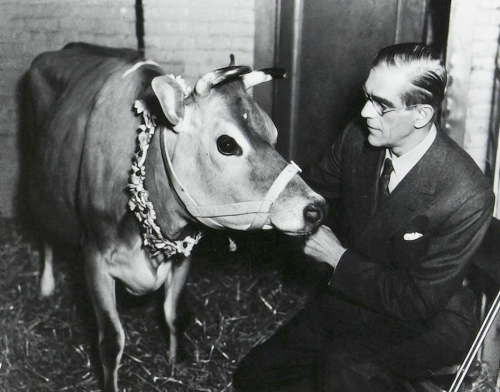
Boris had a great love of animals, and cared for several dogs, chickens, turkeys, a cow, and a pet pig at his farmhouse. He also tended a vegetable farm and flower garden on his property. In the A&E documentary The Gentle Monster, one film historian went so far as to describe Karloff as the “St. Francis of Assisi of horror actors.” His other hobbies included playing soccer and cricket.
Boris with Elsie the cow.
The sources I’ve read unanimously describe Karloff as an extraordinarily kind and gentle person, though the press seemed to have trouble reconciling his kind personality with his villainous film roles. Boris himself claimed negative social effects from being typecast: “I’m a quiet citizen, I have my home, my dogs and my orchids. I vote and pat little children on the head. What does it get me? Queer stares from strangers and even more unusual glances from friends. Every time I walk into a room, there is a noticeable lull in the merrymaking.” (Quoted in More Than a Monster.)
However, those who knew him reported a different perception. His wife Dorothy states that these roles were beneficial: “Before Boris began playing sinister parts…he was a much more irritable person than he ever has been since. Whether or not these roles give him the opportunity of purging himself of any latent streaks of malevolence he might ordinarily possess, I cannot say. But I do know that…he is a much sweeter person at home than before. He really is a lamb.” (Quoted in More Than a Monster.)
In a 1941 radio show, Boris referred to himself as “Cuddles Karloff,” which wasn’t inaccurate according to his friends. Cynthia Lindsay recalls, “I never thought of him as a ‘movie star,’ only as a woolly friend. And there is a tactile memory of him that is woolly, the good soft tweeds and the silvery gray hair that had always been shaved for some monstrous role and for which, as it grew furring in, he charged fifty cents a feel. In advance. (Beards were a dollar. They were rarer.)”
Former President Ronald Regan shared his memories of Karloff in a letter to Cynthia Lindsay as “one of the warmest, kindest, most gentle human beings I have ever met, and at all times a perfect gentleman… He had great, good common sense plus a sense of fairness typical of his great integrity.”
As this blog grows, I’ve decided to designate at least one day a month as Scary Scholarly Saturday…or something like that…perhaps a catchier name will come to mind.
Speaking of disturbed minds, this month’s featured academic book is House of Psychotic Women: An Autobiographical Topography of Female Neurosis in Horror and Exploitation Films by Kier-La Janisse. This isn’t your typical film criticism book, but rather an analysis of selected films through an autobiographical lens. As the title suggests, it’s an examination of neurotic, psychotic, and otherwise “crazy” women in horror and exploitation films. It’s a book that works my nerves on a number of levels, but also has a lot on its favor. So let’s get the perceived negatives out of the way first.
To foreground this discussion, I must point out that I’ve become so disgusted with people casually using the term “crazy” in reference to women. The term itself is rather lazy, and stigmatizes mental illness, but also tends to be used to silence and discredit women in particular. As discussed in an article by Harris O’Malley, men usually don’t label women as crazy in reference to an actual diagnosis, but usually to delegitimize any behavior or emotion that is merely perceived as inconvenient or annoying. This labeling is also often brilliantly mocked and satirized satirized in the spoof women’s magazine Reductress.
So imagine how irked I was with Kier-La Janisse’s statement in the introduction, “every woman I have ever met in my entire life is completely crazy, in one way or another.” Like so many men who use this label to describe women, she often does not refer to any formal diagnosis. In this book as in common parlance, “crazy” is a catch-all term for anything from mere eccentricity to debilitating psychosis. The rest of the book involves relating her own craziness to the on-screen craziness of various female characters. She never does offer a definition of what constitutes craziness, or its elusive opposite, sanity. Likewise, she never posits whether she views women as crazy in an essentialist sense, or that all women are crazy due to the pressures of patriarchal society. Given her description of her horrifically abusive childhood, I was saddened that she constantly labels herself crazy as well. Most of the evidence she presents for her self-described craziness runs along the lines of maladaptive coping behaviors that seem perfectly understandable given her dysfunctional upbringing.
My final criticism is that while horror films do depict a great deal of ” craziness” of different types and degrees, it isn’t a genre specifically about that nebulous category of women’s “craziness.” While I haven’t done a quantitative analysis of the subject, my viewing of thousands of horror films seems to indicate that depictions of mentally ill men are at least as prevalent as those of women, if not more so. Focusing exclusively on “crazy” women excludes their male equivalents. What about Jack Torrence, Norman Bates, and Michael Myers, not to mention scores of mad scientists, serial killers, and cultists? Male craziness is a staple of horror literature. Just ask any of Lovecraft’s protagonists. Janisse even discusses her affinity for the “neurotic” music of Alice Cooper, who has coopted “craziness” and mental illness as part of his personal brand following his treatment at a psychiatric facility. However, she doesn’t explore representations (or self-representations) of male “craziness.” At some point, I would love to see someone compare and contrast gendered constructs of “craziness” within the horror genre. Furthermore, I would eventually like to see a discussion of the perceived benefit of owning “craziness” as a personal brand or label.
On the positive side, Janisse does provide in-depth and thoughtful commentary on many overlooked movies, which are presented alongside her autobiography, and separately in a lengthy appendix. There are also many beautiful black-and-white and full color movie stills and poster reproductions throughout the book. Even though I had issues with the premise, House of Psychotic Women was fun to read. Janisse’s autobiography is interesting in its own right, and it’s fascinating how horror films can resonate with people on so many different levels. Clearly, depictions of “crazy” women serve a cathartic function for Janisse. I am constantly amazed at how many varied readings arise from the horror genre, and this was an aspect I hadn’t previously considered.


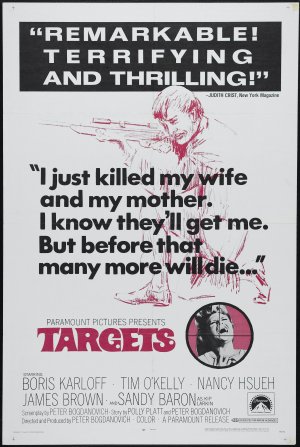
 (1968), directed by Peter Bogdanovich.

 (1941) and its subsequent editions, Harvey M. Checkley argues that whereas many openly neurotic people are deeply good and loving at their core, psychopaths cause tremendous harm because they are able to effectively fit into societal norms. This argument perfectly parallels these characters. Orlok has made a career by nurturing the appearance of evil, albeit on a superficial level. In his personal life, he’s plagued by insecurity. Yet, at his core, he’s a kind and heroic person. In contrast, Thompson has only the appearance of goodness, trustworthiness, and normalcy masking terrifying schemes of destruction.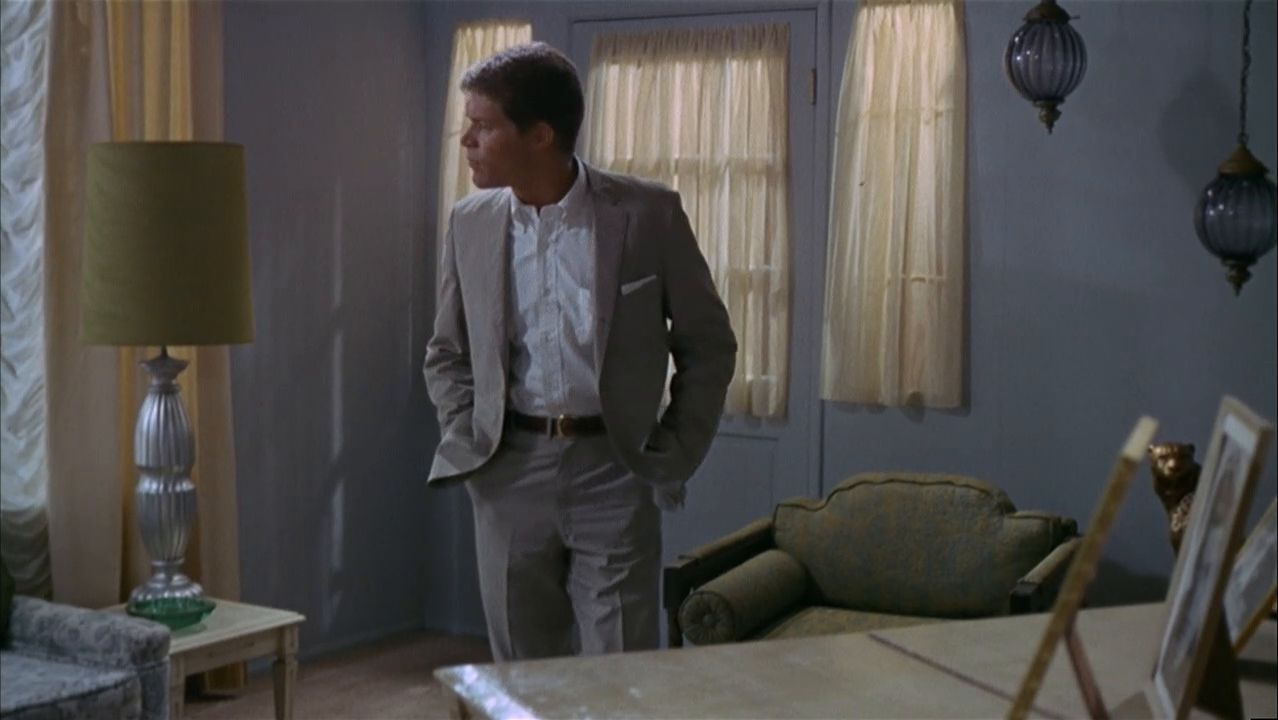
 (1964) and further detailed later in
  , is also pertinent in explaining Thompson’s character. Fromm’s definition of necrophilia is not simply a sexual attraction to corpses, but an attraction to death and destruction for their own sake. Some of the features of character-rooted necrophilia include authoritarianism, the desire to tear apart living things, and fascination with all things mechanical (in this film evidenced by Thompson’s fetishization of guns). As with his inability to differentiate the two-dimensional screen image of Orlok with the man himself, it seems that Thompson doesn’t view his victims as real, or at least not as human. At one point he tells the gun store clerk that he’s going to “hunt some pigs.” Thompson’s use of firearms to dispatch his victims is cold, distant, clinical, and impersonal. This is visually represented by the icy hues and sterile surroundings in Thompson’s scenes. In contrast, Orlok fits within Fromm’s description of the biophilous (life-loving) personality, reflected by the warm, earthy hues in his scenes. Orlok’s home is a bit more ornate, messy, and flawed…as he is. Extrapolate Orlok’s characteristics to the genre he represents, and again, there is an indication that the horror genre is on the side of life.
 by Cynthia Lindsay, who was a friend of Karloff’s for many years. Lindsay’s book is entirely worth reading, as she provides some wonderful insights into Karloff as a kind and devoted friend. But her book raises as many questions as it answers. Despite having been his friend for decades, there were many things that Cynthia did not know about Karloff’s life due to the fact he was a vey private person. Despite her best efforts at research, there were many details she simply could not uncover. Some of these details I found mysterious and unnerving. For example, he never discussed his childhood and revealed his five marriages after many years of friendship. I wonder if , in this era in which people share minute details of their lives on social media, people would regard Karloff’s secrecy about his private life with suspicion. Perhaps such discretion regarding personal matters is a lost virtue.
 Scott Allen Nollen. The author was able to consult with Karloff’s daughter, Sara, resulting in a more detailed account of Karloff’s life. My only complaint about this book is that the print is surprisingly small and there is no ebook edition. But if one can overlook the irksome font, this is a delightful book that gives great insight into Karloff’s character.


 My Horrific Life